
Caravaggio’s Revolutionary Naturalism
Caravaggio (1571–1610) was a leading artist of early 17th-century Italian Baroque art, revolutionizing the field with his realistic and intense naturalistic depictions. While Renaissance art at the time emphasized idealized figures, Caravaggio rejected this approach, opting instead to portray people as they appeared in real life. This naturalistic approach was focused on conveying the pain and emotions of his figures with great realism. Additionally, he used a technique known as tenebrism, where strong contrasts between light and dark were employed to create dramatic scenes.
Despite using this innovative style to depict religious themes, Caravaggio portrayed his subjects in a secular, humanized manner. This was an unusual approach in religious art, where sacredness was typically emphasized, but Caravaggio heightened the emotional and physical suffering of his figures. His naturalism shocked the art world and especially highlighted the emotions and situations of the characters through the dramatic use of light and shadow. Though controversial at the time, Caravaggio’s original artistic expression was also widely praised for its boldness.
카라바조의 혁신적 자연주의
카라바조(1571-1610)는 17세기 초 이탈리아 바로크 미술을 대표하는 화가로, 현실적이고 강렬한 자연주의적 묘사로 미술사에 큰 변화를 일으켰다. 당시 예술계는 르네상스 미술의 영향으로 이상화된 인물 표현이 주를 이루었으나, 카라바조는 이를 거부하고 현실 속 인물들을 그대로 묘사하는 방식을 택했다. 이러한 자연주의적 접근은 그의 작품에서 인물들의 고통과 감정을 사실적으로 표현하는 데 중점을 두었다. 또한, 그는 테네브리즘이라고 불리는 강렬한 명암 대비 기법을 통해 극적인 장면을 연출하였다.
카라바조는 이러한 혁신적 스타일로 종교적 주제를 그렸지만, 그 인물들은 세속적이고 인간적인 모습으로 묘사되었다. 이는 당시 종교 미술에서 보기 드문 접근법으로, 신성함을 강조하기보다 인물들이 겪는 감정과 고통을 극대화한 것이 특징이다. 그의 자연주의적 접근은 미술계에 큰 충격을 주었으며, 특히 빛과 어둠을 극적으로 대비시켜 인물의 감정과 상황을 더욱 부각하였다. 이로 인해 카라바조의 작품은 당대 관객들 사이에서 논란을 불러일으켰으나, 동시에 그의 독창적인 예술적 표현력에 대한 찬사를 받았다.

Masterpiece: The Calling of Saint Matthew (1599–1600)
One of Caravaggio’s most famous religious works, The Calling of Saint Matthew, was painted for the Contarelli Chapel in the Church of San Luigi dei Francesi in Rome. The painting depicts Jesus calling the tax collector Matthew to become one of his disciples, presented in a groundbreaking way. Jesus and Saint Peter are dressed in humble, everyday clothing and illuminated by a beam of light from a window. Matthew, in the midst of his tax office, gestures to himself in surprise, as if asking, “Is it me?”
Caravaggio made light a key element in this work, with divine light from outside rather than natural sunlight illuminating the figures. Jesus and Peter are shown in simple clothing and depicted as contemporary figures. The composition and use of light sparked controversy in the art world, but it also helped viewers to engage deeply with the scene. This style showcases Caravaggio’s originality and highlights the transformative impact he had on the art world of his time.
대표작 “성 마태오의 소명” (1599-1600)
카라바조의 “성 마태오의 소명“은 그가 산 루이지 데이 프란체시 성당을 위해 그린 대표적인 종교화 중 하나다. 이 작품은 예수가 세리 마태오를 제자로 부르는 장면을 묘사하고 있으며, 당시로서는 매우 파격적인 방식으로 그려졌다. 예수와 성 베드로는 세속적인 복장을 한 채, 한쪽 창문에서 들어오는 빛에 의해 강조된다. 마태오는 그가 일하던 세리 사무실에서 예수의 부름을 받는 순간, 놀라움과 혼란 속에서 자신의 가슴을 가리키며 “나인가?”를 묻는 듯한 제스처를 취한다.
카라바조는 이 작품에서 빛을 매우 중요한 요소로 사용하였으며, 창문으로 들어오는 자연광이 아닌, 외부에서 오는 신성한 빛이 인물들에게 비치고 있다. 예수와 베드로는 간단한 복장을 하고 있으며, 현대적인 인물로 묘사되었다. 이 작품의 구성과 빛의 사용은 당시 예술계에서 논란을 불러일으켰으나, 그로 인해 관객들이 이 장면에 몰입할 수 있도록 했다. 이와 같은 스타일은 카라바조의 예술적 독창성을 보여주며, 그의 작품들이 당시 미술계에서 어떤 변화를 가져왔는지를 잘 나타낸다.

Judith Beheading Holofernes (1598–1599)
Another of Caravaggio’s major biblical works, Judith Beheading Holofernes, depicts the scene from the Old Testament where Judith saves Israel by decapitating the Assyrian general Holofernes. Caravaggio captures Judith’s determination and fear at the moment of the beheading, dramatically portraying the tension between the characters. Judith’s expression is cold and resolute, yet there is a glimpse of fear beneath the surface.
Caravaggio uses his signature chiaroscuro technique, maximizing the tension between the figures through the contrast of light and shadow. The interaction between Judith and Holofernes is intensely dramatic, allowing viewers to instinctively feel the violence and pain of the scene. Like many of his other religious works, the piece evokes a powerful emotional response despite its violent subject matter.
“유디트와 홀로페르네스의 목을 치는 유디트” (1598-1599)
“유디트와 홀로페르네스의 목을 치는 유디트“는 카라바조의 대표적인 성경 주제 작품으로, 구약 성경에서 이스라엘을 구하기 위해 아시리아 장군 홀로페르네스를 처형하는 장면을 다루고 있다. 카라바조는 이 작품에서 유디트의 결단력과 공포를 동시에 묘사하며, 그녀가 홀로페르네스의 목을 자르는 순간을 극적으로 포착했다. 유디트는 차갑고 결연한 표정을 짓고 있지만, 동시에 그 안에 내재된 두려움이 엿보인다.
카라바조는 이 작품에서 그의 시그니처 기법인 명암 대비를 최대한 활용하여 인물 간의 긴장감을 고조시켰다. 특히, 유디트와 홀로페르네스 사이의 긴장감 넘치는 상호작용이 화면 전체에 걸쳐 극적으로 표현되어 있다. 그의 이러한 묘사는 관객들이 그 장면 속에서 발생한 폭력성과 고통을 직관적으로 느끼게 만든다. 이 작품은 그의 다른 종교 작품들과 마찬가지로 폭력적인 주제를 다루고 있음에도 불구하고, 관객들에게 깊은 감정적 반향을 불러일으킨다.

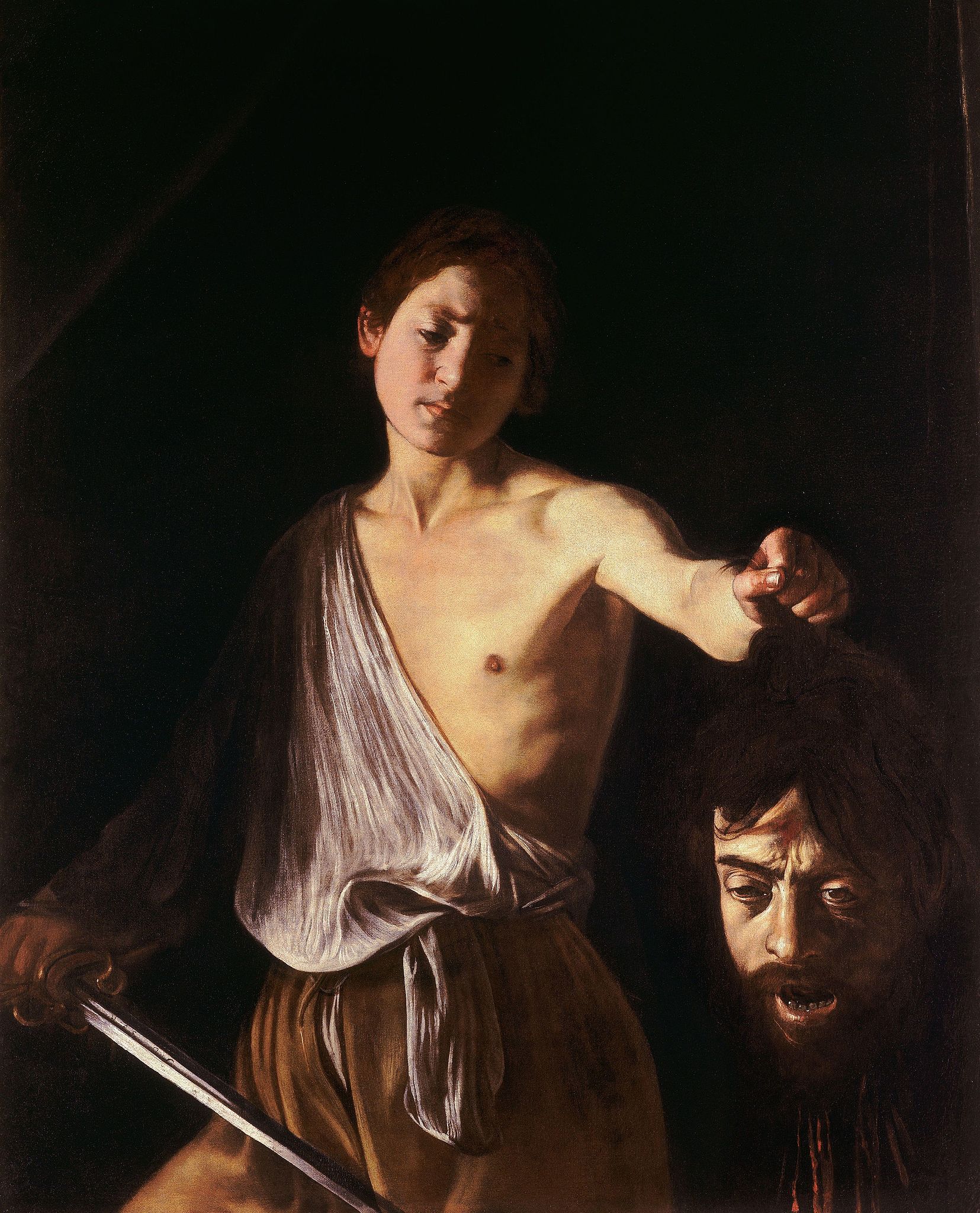
David with the Head of Goliath (1609–1610)
In David with the Head of Goliath, one of Caravaggio’s later works, he notably painted his own face onto Goliath’s severed head. David, holding Goliath’s head, does not appear to rejoice in victory but rather seems weighed down by the sorrow and gravity of death. This reflects Caravaggio’s inner turmoil and guilt, especially significant given that he was a fugitive, accused of murder at the time.
David’s face conveys a complex range of emotions, as Caravaggio sought to portray not just a biblical story but the human conflict within. By projecting his own image onto Goliath, Caravaggio symbolically expressed his struggle with guilt and redemption. This work is a testament to Caravaggio’s artistic maturity and a reflection of the moral conflicts he faced during his life.
“골리앗의 머리를 든 다윗” (1609-1610)
카라바조의 “다윗과 골리앗“은 그의 말년 작품 중 하나로, 자신의 얼굴을 골리앗의 잘린 머리로 묘사한 점이 특징이다. 이 작품에서 다윗은 골리앗의 머리를 들고 있으나, 승리자의 기쁨보다는 인생의 고통과 죽음의 무게를 느끼고 있다. 이는 카라바조가 자신의 내면적 고뇌와 죄책감을 반영한 것으로, 당시 그가 살인 혐의로 도망자 신세였다는 점을 고려하면 더욱 의미가 깊다.
다윗의 얼굴에는 복잡한 감정이 담겨 있으며, 카라바조는 이를 통해 단순한 성경적 이야기가 아닌 인간적 갈등을 묘사하고자 했다. 또한 골리앗의 머리에 자신을 투영함으로써, 카라바조는 자신이 겪은 죄와 속죄의 문제를 상징적으로 표현하였다. 이 작품은 카라바조가 예술적 성숙기에 이르렀음을 보여주는 동시에, 그의 내면적 갈등과 도덕적 고민을 엿볼 수 있는 중요한 작품이다.

A Life of Drastic Escalation
Caravaggio’s life was as dramatic and tumultuous as his art. Following a murder incident in Rome, he became a fugitive, moving between Naples, Malta, and Sicily while continuing his artistic work. Despite his unstable life, he maintained his artistic prowess, creating several masterpieces. His time in Malta was especially notable, as he received patronage from the Knights of St. John and completed significant works. However, his violent tendencies led to his expulsion from the order after another altercation.
Returning to Naples, Caravaggio’s final works reflect his increasing inner turmoil and guilt. These pieces, darker in tone and subject matter, indicate the growing unrest in his life. His violent nature and frequent conflicts eventually led to his downfall, but throughout it all, Caravaggio continued to express himself through his art.
파격적인 삶의 연속
카라바조의 삶은 그의 예술만큼이나 극적이고 불안정했다. 그는 로마에서의 살인 사건으로 인해 도망자 신세가 되었으며, 이후 나폴리, 몰타, 시칠리아 등 여러 지역을 전전하며 작품 활동을 이어갔다. 카라바조는 이러한 불안정한 삶 속에서도 그의 예술적 기량을 유지하며 수많은 걸작을 남겼다. 특히 몰타에서 성 요한 기사단의 후원을 받아 중요한 작품들을 남겼지만, 또다시 폭력 사건에 연루되어 기사단에서 추방되었다.
그는 몰타를 떠난 후 나폴리로 돌아가 작품 활동을 이어갔으나, 그가 남긴 마지막 작품들은 그의 내면적 불안과 죄책감을 반영한 것들로, 그의 예술적 세계가 점점 더 어두워지고 있음을 보여준다. 카라바조의 이러한 삶은 그의 예술적 성취와 개인적 파멸이 끊임없이 얽혀 있음을 나타낸다. 그의 폭력적 성향과 잦은 분쟁은 그를 결국 파멸로 이끌었으나, 그 속에서도 그는 끊임없이 자신을 표현하고자 했다.

The Escape from Malta and Final Works
Caravaggio’s time in Malta was a key period in his life, where he received patronage from the Knights of St. John and created several masterpieces. However, his involvement in yet another violent incident led to his imprisonment and eventual expulsion from the order. After a dramatic escape, Caravaggio returned to Naples, where he completed his final works. The Beheading of Saint John the Baptist, one of his last and only signed works, was produced during this time.
This work exemplifies Caravaggio’s artistic mastery, as he used intense contrasts of light and shadow to emphasize the drama of Saint John’s execution. His portrayal of this violent scene reveals his internal conflicts and desire for redemption. Today, the painting is recognized as one of his greatest masterpieces, symbolizing the culmination of his artistic journey.
몰타에서의 탈출과 마지막 작품
몰타에서의 생활은 카라바조의 생애에서 중요한 시기였다. 그는 성 요한 기사단의 후원을 받아 여러 걸작을 남겼지만, 또다시 폭력 사건에 연루되어 기사단에서 추방되었다. 감옥에 갇힌 카라바조는 교묘하게 탈출에 성공하여 나폴리로 돌아갔으며, 그곳에서 그의 마지막 작품들을 남겼다. 이 시기의 대표작인 “성 요한 세례자의 참수“는 그의 생애 마지막 작품 중 하나로, 카라바조가 자신의 서명을 남긴 유일한 작품이기도 하다.
“성 요한 세례자의 참수“는 카라바조의 예술적 경지의 절정을 보여주는 작품으로, 그는 이 작품에서 자신의 내면적 갈등과 속죄의 욕구를 표현하였다. 특히 이 작품에서 그는 강렬한 빛과 어둠의 대비를 통해 성 요한의 처형 장면을 더욱 극적으로 묘사하였다. 이 작품은 그의 예술적 완성도를 높이 평가받고 있으며, 오늘날에도 그의 가장 중요한 걸작 중 하나로 평가받고 있다.

Caravaggio’s Legacy
Caravaggio broke away from the traditional, formal approach to religious art, shifting the focus to raw human emotions and suffering. His work had a profound influence on Baroque artists and continues to impact modern art. His dramatic use of light and shadow has inspired countless artists, and despite the violence and instability of his life, his artistic achievements remain enduring and influential.
카라바조의 유산
카라바조는 당시 종교적이고 형식적인 미술에서 벗어나, 인간의 고통과 감정을 있는 그대로 묘사하는 방식으로 미술의 패러다임을 바꾸었다. 그의 작품은 후대 바로크 화가들뿐만 아니라 현대 미술에서도 큰 영향을 미쳤으며, 그의 강렬한 빛과 어둠의 대비 기법은 수많은 예술가들에게 영감을 주었다. 비록 그의 삶은 폭력과 도망으로 얼룩져 있었지만, 예술가로서의 그의 업적은 영원히 기억될 것이다.

Keywords: Caravaggio, Michelangelo Merisi da Caravaggio, Baroque art, tenebrism, The Calling of Saint Matthew, Judith Beheading Holofernes, David with the Head of Goliath, The Beheading of Saint John the Baptist, Caravaggio murder case, Caravaggio biography
키워드: 카라바조, Michelangelo Merisi da Caravaggio, 바로크 미술, 테네브리즘, 성 마태오의 소명, 유디트와 홀로페르네스, 다윗과 골리앗, 성 요한 세례자의 참수, 카라바조 살인 사건, 카라바조 생애
References:
- The Controversial Life and Works of Caravaggio – History Collection
- Caravaggio Paintings, Bio, Ideas – TheArtStory
- Caravaggio | Biography, Paintings, Style, & Facts – Britannica
- Tracing the Turbulent Life of Baroque Painter Caravaggio
Leave a Reply