
Birth and Early Life of the Neoclassical Pioneer, Jacques-Louis David
Jacques-Louis David (August 30, 1748 – December 29, 1825) was born into a wealthy middle-class family in Paris, France. His father, Louis David, worked as a real estate broker but died in a duel when David was only nine years old. Consequently, he was raised by his mother, Marie-Geneviève Buron, and his uncles. From a young age, David exhibited a passion and talent for art, and his family supported and encouraged his artistic inclinations. However, his academic performance was poor, and he struggled with a speech impediment that made communication difficult.
David enrolled in the Royal Academy of Painting and Sculpture in Paris to receive formal art education. Recommended by François Boucher, a leading Rococo artist of the time, he became a student of Joseph-Marie Vien, who was reviving classical art forms. Vien introduced David to the aesthetics and values of ancient art. In 1774, David won the Prix de Rome, the highest honor for French artists, allowing him to study in Italy.
In Rome, he directly observed and studied the artworks of ancient Greece and Rome, solidifying his neoclassical style. During this period, he was profoundly influenced by Renaissance masters like Michelangelo and Raphael. David expanded his artistic worldview through his experiences in Italy, moving toward classical aesthetics and strict forms. He delved deeply into human emotions and moral values while dealing with historical and mythological subjects. Returning to France in 1780, he began establishing his unique artistic realm as a pioneer of Neoclassicism. His works distinctly differed from the previous Rococo style, embedding critical perspectives on society and politics.
신고전주의의 선구자, 자크 루이 다비드의 탄생과 초기 생애
자크 루이 다비드(1748년 8월 30일 ~ 1825년 12월 29일)는 프랑스 파리에서 부유한 중산층 가정에서 태어났다. 그의 아버지 루이 다비드는 부동산 중개업자로 활동했지만, 다비드가 아홉 살 때 결투로 사망하였다. 이로 인해 그는 어머니 마리 제느비에브 부롱(Marie-Geneviève Buron)과 친척들의 보살핌 아래 성장하게 되었다. 어린 시절부터 그는 미술에 대한 열정과 재능을 보였으며, 가족들은 그의 예술적 성향을 지지하고 격려하였다. 그러나 학업 성적은 좋지 않았으며, 특히 말더듬이로 인해 의사소통에 어려움을 겪었다.
다비드는 파리의 왕립 회화 및 조각 아카데미(Royal Academy of Painting and Sculpture)에 입학하여 정식으로 미술 교육을 받았다. 그는 당시 로코코 양식의 거장인 프랑수아 부셰(François Boucher)의 추천으로 조제프 마리 비앙(Joseph-Marie Vien)의 제자가 되었다. 비앙은 고전주의의 부활을 추구하는 예술가로, 다비드에게 고대 예술의 미학과 가치를 전수하였다. 1774년, 다비드는 프랑스 예술가들에게 최고의 영예로 여겨지는 로마 대상(Prix de Rome)을 수상하여 이탈리아로 유학을 떠났다.
로마에서 그는 고대 그리스와 로마의 예술 작품들을 직접 관찰하고 연구하며, 신고전주의 양식을 확고히 다졌다. 이 시기에 그는 미켈란젤로와 라파엘로 등의 르네상스 거장들의 작품에도 큰 감명을 받았다. 다비드는 이탈리아에서의 경험을 통해 예술적 세계관을 넓혔으며, 고전적 미학과 엄격한 형식을 추구하는 방향으로 나아갔다. 그는 역사적이고 신화적인 주제를 다루면서도 인간의 감정과 도덕적 가치를 깊이 있게 탐구하였다. 1780년에 프랑스로 돌아온 그는 신고전주의의 선구자로서 독자적인 예술 세계를 구축하기 시작하였다. 그의 작품들은 이전의 로코코 양식과는 뚜렷이 구분되며, 사회와 정치에 대한 비판적 시각을 담고 있었다.

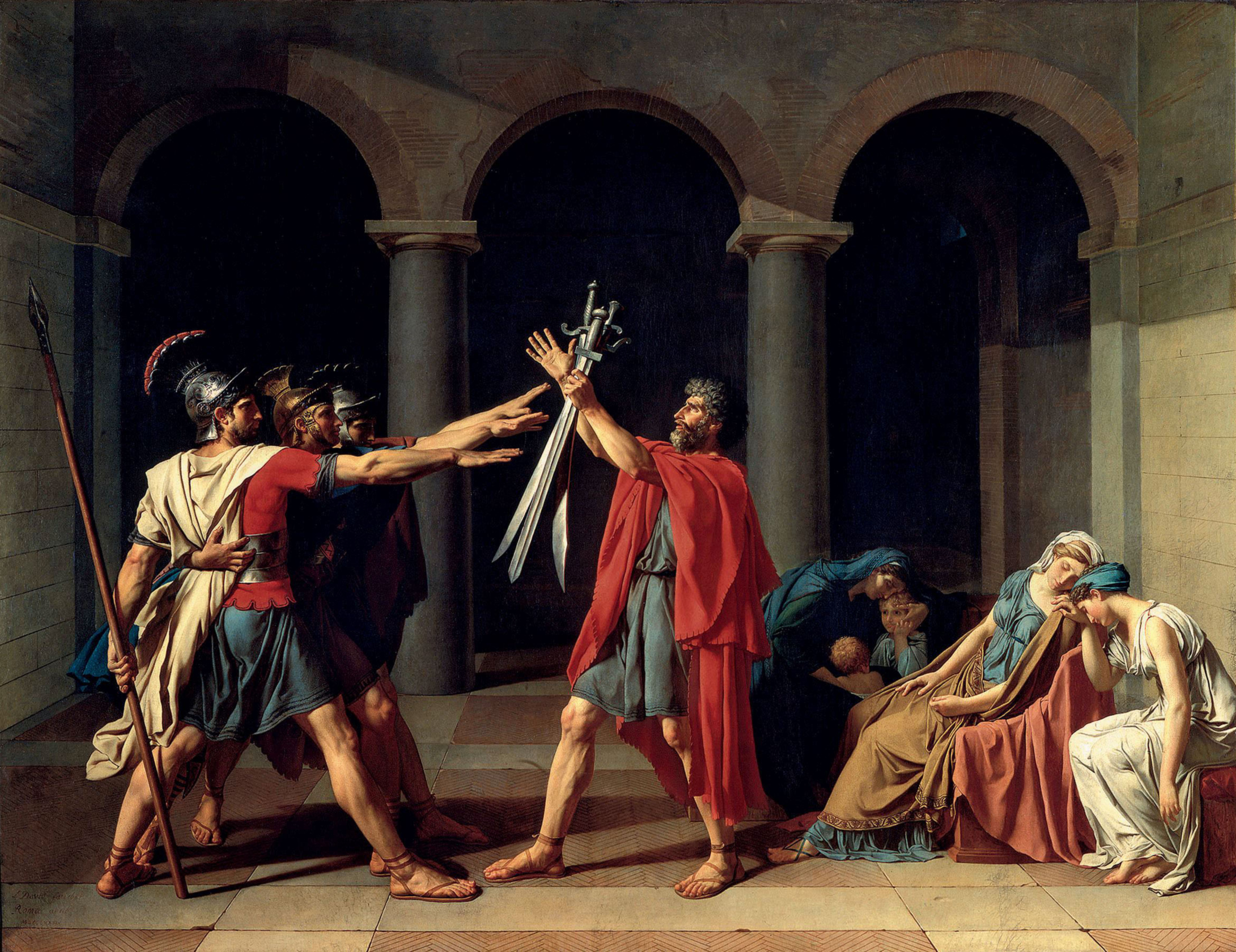
“The Oath of the Horatii”: The Aesthetics of Loyalty and Sacrifice
“The Oath of the Horatii” (1784) solidified David’s reputation and is considered a masterpiece of Neoclassicism. The painting depicts the three sons of the Horatius family swearing an oath before their father to fight for Rome against Alba Longa. The composition is marked by strong symmetry and clear lines, with the postures and expressions of the characters conveying determination and solemnity.
David used strong straight lines, simple colors, and clear composition to express the inner emotions of the characters. The father’s gesture of extending swords to his sons symbolizes loyalty and sacrifice to family and state. In contrast, the women on the right express sorrow and anxiety caused by war, adding a human emotional layer. Through this work, David sought to convey the political tension and the importance of moral values prevalent in French society at the time.
“The Oath of the Horatii” garnered significant attention at the Salon exhibition, propelling David to the forefront of the French art scene. The painting inspired many artists and set the standards for Neoclassical art. It also reflected the pre-revolutionary social atmosphere in France, promoting the message that individual sacrifice is necessary for the communal good, thus contributing to the ideological foundation of the French Revolution.
“호라티우스 형제의 맹세”: 충성과 희생의 미학
“호라티우스 형제의 맹세”(1784)는 다비드의 명성을 확고히 한 작품으로, 신고전주의의 대표작으로 손꼽힌다. 이 작품은 로마 전설에 나오는 호라티우스 가문의 세 형제가 알바 롱가와의 전쟁에서 로마를 대표하여 싸우기 전, 아버지 앞에서 맹세하는 장면을 그린 것이다. 그림은 강렬한 대칭성과 명확한 선으로 구성되어 있으며, 인물들의 자세와 표정은 결의와 비장함을 나타낸다.
다비드는 이 작품에서 강한 직선과 단순한 색채, 그리고 명확한 구도를 통해 인물들의 내면적인 감정을 표현하였다. 아버지가 검을 들고 세 아들에게 내밀고 있는 모습은 가족과 국가에 대한 충성과 희생의 상징으로 해석된다. 반면에 오른쪽에 배치된 여성들은 전쟁으로 인한 슬픔과 불안을 나타내며, 인간적인 감정을 더해준다. 다비드는 이 작품을 통해 당시 프랑스 사회에 만연한 정치적 긴장과 도덕적 가치의 중요성을 전달하려 하였다.
“호라티우스 형제의 맹세”는 살롱(Salon) 전시회에서 큰 화제를 모았으며, 다비드를 프랑스 예술계의 중심인물로 부상시켰다. 이 작품은 이후 많은 예술가들에게 영감을 주었으며, 신고전주의 미술의 기준을 세웠다. 또한 이 작품은 프랑스혁명 이전의 사회적 분위기를 반영하며, 개인의 희생이 공동체의 이익을 위해 필요하다는 메시지를 전달하였다. 이는 당시의 정치적 상황과 맞물려 혁명의 사상적 기반을 형성하는 데에도 기여하였다.

Revolutionary Ideals Captured on Canvas: “The Death of Marat”
“The Death of Marat” (1793) was painted amidst the turmoil of the French Revolution, depicting the assassination of revolutionary leader Jean-Paul Marat in a realistic yet idealized manner. Marat was an influential thinker and journalist during the revolution, and his death brought immense shock and sorrow to revolutionary forces.
David portrayed Marat lying in his bathtub, clutching a letter from his assassin, Charlotte Corday. Marat is depicted with a peaceful expression, devoid of pain, symbolizing his idealization as a martyr. The simplistic background and darkness accentuate his sacrifice, while light highlights his face and upper body.
Through this painting, David aimed to express the ideals and purity of the revolution, deeply moving the public. “The Death of Marat” exemplifies how art can serve as a powerful medium for conveying political messages, significantly influencing subsequent political artworks. By adopting imagery reminiscent of religious martyrs, David elevated Marat to a saint of the revolution, demonstrating how art can create new icons by intertwining with political ideologies.
혁명의 화폭에 담긴 이상, “마라의 죽음”
“마라의 죽음”(1793)은 다비드가 프랑스혁명의 혼란 속에서 그린 작품으로, 혁명가 장 폴 마라의 암살을 사실적이면서도 이상화된 형태로 묘사하고 있다. 마라는 혁명 기간 동안 급진적인 사상가이자 언론인으로 활동했으며, 그의 죽음은 혁명 세력에게 큰 충격과 슬픔을 안겨주었다.
다비드는 마라를 욕조에 누워 있는 모습으로 그렸으며, 그의 손에는 암살자 샤를로트 코르데(Charlotte Corday)가 보낸 편지가 쥐어져 있다. 그림에서 마라는 고통 없이 평온한 표정으로 묘사되었으며, 이는 그를 순교자로 이상화하려는 의도로 해석된다. 주변의 단순한 배경과 어둠은 마라의 희생을 더욱 강조하며, 빛은 그의 얼굴과 상반신을 부각한다.
다비드는 이 작품을 통해 혁명의 이상과 순수성을 표현하고자 하였으며, 이는 대중들에게 깊은 감동을 주었다. “마라의 죽음”은 예술이 정치적 메시지를 전달하는 강력한 수단이 될 수 있음을 보여주는 대표적인 예로, 이후의 정치적 예술 작품들에 큰 영향을 미쳤다. 이 작품은 또한 종교적인 순교자들의 이미지를 차용하여 마라를 혁명의 성자로 묘사함으로써 혁명에 대한 다비드의 헌신을 나타낸다. 이는 예술이 어떻게 정치적 이념과 결합하여 새로운 아이콘을 만들어낼 수 있는지를 보여준다.

Companionship with Napoleon: “Napoleon Crossing the Alps”
Following the French Revolution, David formed a close relationship with Napoleon Bonaparte, playing a crucial role in shaping his image. “Napoleon Crossing the Alps” (1801) portrays Napoleon heroically crossing the Great St. Bernard Pass in the Alps during the 1800 Italian campaign.
In the painting, Napoleon is depicted riding a rearing horse, advancing against fierce winds. His determined expression and fluttering garments add dynamism. David idealized Napoleon as a heroic figure, emphasizing his courage and leadership. Below the horse on the rocks are inscribed the names “BONAPARTE,” “HANNIBAL,” and “KAROLUS MAGNUS,” linking Napoleon to historical greats.
Commissioned by Napoleon, the painting played a significant role in political propaganda. David produced five versions of this work, disseminating Napoleon’s image in various places. “Napoleon Crossing the Alps” exemplifies how art can collaborate with political power to construct imagery. The painting also introduced Romantic elements, influencing subsequent artistic movements. Through this work, David demonstrated how art can idealize contemporary heroes and stimulate public imagination.
나폴레옹과의 동행, “알프스를 가로지르는 나폴레옹”
다비드는 프랑스혁명 이후 등장한 나폴레옹 보나파르트와 긴밀한 관계를 맺으며 그의 이미지를 형성하는 데 중요한 역할을 하였다. “알프스를 가로지르는 나폴레옹”(1801)은 나폴레옹이 1800년 이탈리아 원정을 위해 알프스 산맥의 그레이트 세인트버나드 패스(Great St. Bernard Pass)를 넘는 장면을 영웅적으로 묘사한 작품이다.
그림에서 나폴레옹은 사나운 말을 타고 거센 바람을 맞서며 전진하는 모습으로 그려졌다. 그의 표정은 결의에 차 있으며, 옷자락과 망토는 바람에 휘날려 역동성을 더한다. 다비드는 이 작품에서 나폴레옹을 영웅적이고 이상화된 인물로 묘사하여 그의 용맹함과 리더십을 강조하였다. 말의 바위 아래에는 “BONAPARTE”라는 이름이 새겨져 있으며, 그 아래에는 “HANNIBAL”과 “KAROLUS MAGNUS”가 새겨져 있는데, 이는 역사적인 위인들과의 연속성을 나타낸다.
이 작품은 나폴레옹의 요청으로 제작되었으며, 그의 정치적 선전에 큰 역할을 하였다. 다비드는 이 그림을 다섯 개의 버전으로 제작하여 나폴레옹의 이미지를 다양한 장소에 전파하였다. “알프스를 가로지르는 나폴레옹”은 예술이 정치권력과 어떻게 협력하여 이미지를 구축할 수 있는지를 보여주는 대표적인 사례이다. 이 작품은 또한 낭만주의적 요소를 도입하여 이후의 예술적 흐름에도 영향을 미쳤다. 다비드는 이를 통해 예술이 시대의 영웅을 어떻게 이상화하고 대중의 상상력을 자극할 수 있는지를 보여주었다.

At the Intersection of Politics and Art: David’s Revolutionary Participation
David was not only an artist but also an active revolutionary. He joined the Jacobin Club and worked closely with Maximilien Robespierre in the revolutionary government. Elected as a deputy to the National Convention, he participated in formulating and implementing revolutionary policies. Additionally, he was deeply involved in planning public events and creating revolutionary monuments during the revolution.
He contributed to dismantling symbols of the monarchy and constructing the image of the new republic, orchestrating significant events like the funerals of revolutionary martyrs. Known as the “Painter of the Revolution,” David sought to convey revolutionary ideals and values through art. His works vividly captured the political atmosphere and ideology of the time, demonstrating how art can serve as a tool for social transformation.
However, following Robespierre’s fall, David was arrested and imprisoned. During his incarceration, he reflected deeply on his fate and the ideals of the revolution, subsequently withdrawing from political activities to focus more on art. David’s revolutionary involvement is a crucial example of how art and politics can be closely intertwined, offering profound insights into the social role of art. It suggests that art can transcend aesthetic expression to become a driving force for social change.
정치와 예술의 교차로, 다비드의 혁명적 참여
다비드는 예술가로서뿐만 아니라 적극적인 혁명가로서도 활동하였다. 그는 자코뱅파에 가입하여 막시밀리앙 로베스피에르와 함께 혁명 정부에서 중요한 역할을 맡았다. 다비드는 국민 공회의 의원으로 선출되어 혁명 정책의 수립과 실행에 참여하였다. 또한, 혁명 기간 동안 그는 공공 행사의 기획과 혁명 기념물의 제작에 깊이 관여하였다.
그는 왕정의 상징들을 제거하고 새로운 공화국의 이미지를 구축하는 데 기여하였으며, 혁명 순교자들의 장례식과 같은 중요한 행사들을 예술적으로 연출하였다. 다비드는 “혁명의 화가”로 불리며, 예술을 통해 혁명의 이상과 가치를 전달하려 하였다. 그의 작품들은 당시의 정치적 분위기와 이념을 생생하게 담고 있으며, 예술이 사회 변혁의 도구로 사용될 수 있음을 보여준다.
그러나 로베스피에르의 몰락과 함께 다비드도 체포되어 감옥에 수감되었다. 감옥에서 그는 자신의 운명과 혁명의 이상에 대해 깊은 성찰을 하였으며, 이후 정치적 활동에서 한 발 물러나 예술에 더욱 집중하게 되었다. 다비드의 혁명적 참여는 예술과 정치가 어떻게 밀접하게 연관될 수 있는지를 보여주는 중요한 사례로, 그의 작품들은 예술의 사회적 역할에 대한 깊은 통찰을 제공한다. 이는 예술이 단순한 미적 표현을 넘어 사회 변화의 원동력이 될 수 있음을 시사한다.

Lesser-Known Stories: The Human Side of David
While Jacques-Louis David was known for his strict and perfectionist nature, there are many intriguing anecdotes about his human side. He emphasized rigorous discipline and training when teaching his students but also endeavored to respect their creativity and individuality. His atelier produced influential artists like Jean-Auguste-Dominique Ingres and Antoine-Jean Gros, who significantly impacted French art.
David was deeply interested in music and literature, engaging in various cultural activities through interactions with other artists. He was sociable with a keen sense of humor, enjoying gatherings with friends. He valued his family highly, maintaining a relationship filled with affection and trust with his wife, Marguerite-Charlotte Pecoul. Their marriage was stable, and David was attentive to his children.
His letters and diaries reveal not only his artistic concerns but also his personal emotions and struggles. He suffered from health issues, including a facial tumor that made speaking and eating difficult. Despite personal hardships, he never lost his passion for art, reflected in the deep sensitivity and humanity in his works. He also showed a humane side in his relationships with students, genuinely celebrating their successes. These stories illustrate that David was not merely a strict artist but a person with a warm heart.
덜 알려진 이야기들, 다비드의 인간적인 면모
자크 루이 다비드는 엄격하고 완벽주의적인 성격으로 알려져 있지만, 그의 인간적인 면모와 관련된 흥미로운 일화들도 많다. 그는 학생들을 지도할 때 엄격한 규율과 훈련을 강조하였지만, 동시에 그들의 창의성과 개성을 존중하려 노력하였다. 그의 아틀리에는 앵그르(Jean-Auguste-Dominique Ingres), 앙투안 장 그로(Antoine-Jean Gros) 등 후에 프랑스 미술계에 큰 영향을 미친 예술가들이 배출되었다.
다비드는 음악과 문학에도 깊은 관심을 가지고 있었으며, 예술가들과의 교류를 통해 다양한 문화 활동에 참여하였다. 그는 사교적이고 유머 감각이 뛰어난 인물로서, 친구들과의 모임을 즐겼다. 또한, 그는 가족을 매우 소중히 여겼으며, 특히 아내 마르그리트 샤를로트 페쿨(Marguerite-Charlotte Pecoul)과의 관계는 깊은 애정과 신뢰로 가득 차 있었다. 그들의 결혼 생활은 안정적이었으며, 다비드는 자녀들에게도 많은 관심을 기울였다.
그의 서신과 일기에서는 예술가로서의 고민뿐만 아니라 인간적인 감정과 고민들이 드러난다. 그는 건강 문제로 고통받았으며, 얼굴에 생긴 종양으로 인해 발음과 식사에 어려움을 겪었다. 이러한 개인적인 어려움 속에서도 그는 예술에 대한 열정을 잃지 않았으며, 이는 그의 작품에 담긴 깊은 감성과 인간성으로 나타난다. 또한 그는 학생들과의 관계에서도 인간적인 면모를 보여주었으며, 그들의 성공을 진심으로 기뻐하였다. 그의 인간적인 이야기들은 다비드가 단순히 엄격한 예술가가 아니라 따뜻한 마음을 지닌 사람이었음을 보여준다.

Exile and Later Years: David’s Artistic Legacy
Due to political pressure and threats following Napoleon’s fall and the Bourbon Restoration, David was exiled from France in 1816 and moved to Brussels. Although exile brought loneliness and a sense of loss, he continued his artistic endeavors. During this period, he created works like “Mars Being Disarmed by Venus and the Three Graces” (1824), his last great piece, shifting from political subjects to mythological and romantic themes.
In exile, David taught many students, spreading his artistic philosophy and techniques. His atelier was vibrant with young artists from across Europe, whom he instructed in classical aesthetics and strict artistic principles. David also reflected on his artistic achievements and life, leaving behind autobiographical writings.
He passed away in Brussels in 1825 at the age of 77. His remains were not returned to France and were buried locally, as the restored monarchy refused to allow his body back. However, there are accounts that his heart was brought back to Paris by his family and interred at Père Lachaise Cemetery. Although his exile and later years were challenging, his artistic passion and achievements shone brighter than ever. His later works exhibited different emotions and themes, showing an expansion of his artistic range.
망명과 말년, 다비드의 예술적 유산
나폴레옹의 몰락과 왕정복고로 인해 다비드는 정치적 압박과 위협을 받게 되었다. 그는 1816년 프랑스로부터 추방되어 브뤼셀로 망명하였다. 망명 생활은 그에게 고독과 상실감을 안겨주었지만, 그는 여전히 작품 활동을 이어갔다. 이 시기에 그는 “사랑의 신에게 무장해제되는 마르스”(Mars Being Disarmed by Venus, 1824)와 같은 작품을 제작하였다. 이 작품은 그의 마지막 대작으로, 이전의 정치적 주제에서 벗어나 신화적이고 낭만적인 주제를 다루었다.
망명 기간 동안 다비드는 많은 제자들을 지도하며 그의 예술적 철학과 기법을 전파하였다. 그의 아틀리에는 유럽 각지에서 온 젊은 예술가들로 활기를 띠었으며, 그는 그들에게 고전적 미학과 엄격한 예술적 원칙을 가르쳤다. 다비드는 또한 자신의 예술적 성취와 인생에 대해 회고하며, 자서전적인 글을 남기기도 하였다.
1825년, 그는 브뤼셀에서 77세의 나이로 생을 마감하였다. 그의 유해는 프랑스로 돌아가지 못하고 현지에 안장되었다. 당시 복고 왕정은 그의 시신의 반환을 거부하였기 때문이다. 그러나 그의 심장은 가족들에 의해 파리로 돌아와 페르 라셰즈 묘지에 안장되었다는 이야기도 있다. 다비드의 망명과 말년은 그의 삶에서 힘든 시기였지만, 그의 예술적 열정과 업적은 그 어느 때보다 빛났다. 그의 말년 작품들은 이전과는 다른 감성과 주제를 담고 있어 예술적 범위의 확장을 보여준다.

David’s Influence and Position in Modern Art
Jacques-Louis David played a decisive role in establishing and developing Neoclassicism, with his influence extending to future generations. His students propagated Neoclassicism throughout Europe, significantly altering the direction of European art. David’s art demonstrated that it could be a means of conveying social and political messages, not just formal aesthetics.
His works influenced subsequent art movements like Romanticism and Realism, opening new possibilities in historical and portrait painting. In modern art, David’s works remain vital subjects of study and education, with his artistic techniques and philosophy still relevant. Art historians and artists gain new insights into the essence and role of art through his works.
David redefined the role of the artist, deeply exploring the relationship between art and society. His works continue to receive new interpretations and meanings through exhibitions and research, securing an immortal place in art history. His artistic legacy will provide ongoing inspiration and value to future artists and audiences. David’s influence spread globally beyond France, remaining an essential example of the interplay between art, politics, and society. It illustrates how art can reflect and even drive the changes of its time.
다비드의 영향과 현대 미술에서의 위치
자크 루이 다비드는 신고전주의를 정립하고 발전시키는 데 결정적인 역할을 하였으며, 그의 영향은 후대에까지 지속되었다. 그의 제자들은 유럽 전역에서 활동하며 신고전주의를 확산시켰고, 이는 유럽 미술의 방향을 바꾸는 데 큰 기여를 하였다. 다비드의 예술은 단순히 형식적인 미학에 그치지 않고, 예술이 사회적, 정치적 메시지를 전달하는 수단이 될 수 있음을 보여주었다.
그의 작품들은 낭만주의와 사실주의 등 이후의 미술 운동에도 영향을 미쳤으며, 특히 역사화와 인물화에서 새로운 가능성을 열어주었다. 현대 미술에서도 다비드의 작품은 연구와 교육의 중요한 대상으로 남아 있으며, 그의 예술적 기법과 철학은 여전히 유효하다. 미술사학자들과 예술가들은 그의 작품을 통해 예술의 본질과 역할에 대해 새로운 통찰을 얻고 있다.
다비드는 예술가로서의 역할을 재정의하며, 예술과 사회의 관계를 깊이 탐구한 선구자로서 인정받고 있다. 그의 작품들은 오늘날에도 전시와 연구를 통해 새로운 해석과 의미를 부여받고 있으며, 미술사에서 불멸의 위치를 차지하고 있다. 그의 예술적 유산은 미래의 예술가들과 관객들에게도 지속적인 영감과 가치를 제공할 것이다. 다비드의 영향력은 프랑스를 넘어 전 세계적으로 확산되었으며, 그의 작품들은 예술과 정치, 사회의 상호작용에 대한 중요한 사례로 남아 있다. 이는 예술이 어떻게 시대의 변화를 반영하고, 또 그 변화를 이끌어낼 수 있는지를 보여준다.

Keywords: Jacques-Louis David, Neoclassicism, The Oath of the Horatii, The Death of Marat, Napoleon Crossing the Alps, French Revolutionary Art, David’s Influence, David’s Life, David’s Major Works, Napoleon and David, David’s Students, David’s Exile, Human Side of David, David’s Artistic Legacy
키워드: 자크 루이 다비드, Jacques-Louis David, 신고전주의, 호라티우스 형제의 맹세, 마라의 죽음, 알프스를 가로지르는 나폴레옹, 프랑스 혁명 미술, 다비드의 영향, 다비드의 생애, 다비드의 대표 작품, 나폴레옹과 다비드, 다비드의 제자들, 다비드의 망명, 다비드의 인간적인 면모, 다비드의 예술적 유산
References:
- Wikipedia – Jacques-Louis David
- Metropolitan Museum of Art – Jacques-Louis David
- Louvre Museum – Collection of David’s Works
- Khan Academy – Jacques-Louis David
- Artcyclopedia – Jacques-Louis David
- Biography.com – Jacques-Louis David Biography
- The Art Story – Artist Overview: Jacques-Louis David
- Encyclopedia Britannica – Jacques-Louis David
Leave a Reply