

Georges Seurat: Painting with a Million Dots of Light
Stand close to a Georges Seurat canvas and it dissolves into confetti — thousands of separate touches of pure colour, blue beside orange, green beside red, none of them blended. Step back, and the eye does the mixing for you: the dots fuse into shimmering, sunlit air. Seurat was born in Paris in 1859 and died there in 1891, barely thirty-one years old, yet in that short life he rewired how a painting could be made. Trained at the École des Beaux-Arts, he grew impatient with both academic polish and the loose spontaneity of the Impressionists. He wanted something the Impressionists had only felt their way toward — a method, almost a science, for putting light itself on canvas.
조르주 쇠라: 백만 개의 빛의 점으로 그리다
조르주 쇠라의 화면에 바짝 다가서면 그림은 색종이 조각처럼 흩어진다 — 순수한 색을 따로따로 찍은 수천 개의 터치, 파랑 옆에 주황, 초록 옆에 빨강, 그 어느 것도 섞이지 않은 채로. 그러나 물러서면, 눈이 대신 색을 섞어 준다. 점들은 융합되어 반짝이는 햇살 가득한 공기가 된다. 쇠라는 1859년 파리에서 태어나 1891년 같은 도시에서, 겨우 서른한 살의 나이로 세상을 떠났다. 그 짧은 생애 동안 그는 그림을 만드는 방식 자체를 다시 배선했다. 에콜 데 보자르에서 수학한 그는 아카데미의 매끈함에도, 인상주의의 느슨한 즉흥성에도 차츰 조바심을 느꼈다. 그는 인상주의자들이 감각으로만 더듬어 가던 것을 — 빛 그 자체를 화폭에 올리는 하나의 방법, 거의 과학에 가까운 방법을 — 원했다.


A Method Built on Science
Seurat read colour theory the way other painters read poetry. He absorbed the writings of Chevreul, Rood and Charles Blanc on how adjacent colours intensify one another, and he turned those laws into a working technique he called chromoluminarism — better known today as Pointillism or Divisionism. Instead of mixing pigments on the palette (which dulls them), he placed small, deliberate strokes of unmixed colour side by side and let them combine in the viewer’s eye, where they stay far more luminous. His first large statement, Bathers at Asnières of 1884, shows working-class Parisians resting by the Seine in a haze of heat and light. It is calm, monumental, almost frozen — figures arranged with the gravity of a classical frieze, yet glowing with the optical vibration of his new science.
과학 위에 세운 방법
쇠라는 다른 화가들이 시를 읽듯 색채 이론을 읽었다. 인접한 색이 서로를 어떻게 강렬하게 만드는지에 관한 슈브뢸, 루드, 샤를 블랑의 글을 흡수했고, 그 법칙들을 크로모뤼미나리슴이라 부른 실제 기법으로 바꾸어 놓았다 — 오늘날 점묘법 혹은 분할묘법으로 더 잘 알려진 것이다. 팔레트에서 안료를 섞는 대신(그러면 색이 탁해진다), 그는 섞지 않은 색의 작고 의도적인 터치들을 나란히 놓아, 그것들이 보는 이의 눈 안에서 결합하게 했다. 그 안에서 색은 훨씬 더 빛난다. 1884년의 첫 대작 아니에르의 물놀이는 더위와 빛의 아지랑이 속에서 센강 가에 쉬고 있는 파리 노동계급을 보여 준다. 고요하고 기념비적이며 거의 얼어붙은 듯한 — 고전 부조의 무게로 배치된 인물들이, 그의 새로운 과학이 만든 시각적 진동으로 환히 빛난다.

_-_BF811_-_Barnes_Foundation.jpg)
The Great Sunday Afternoon
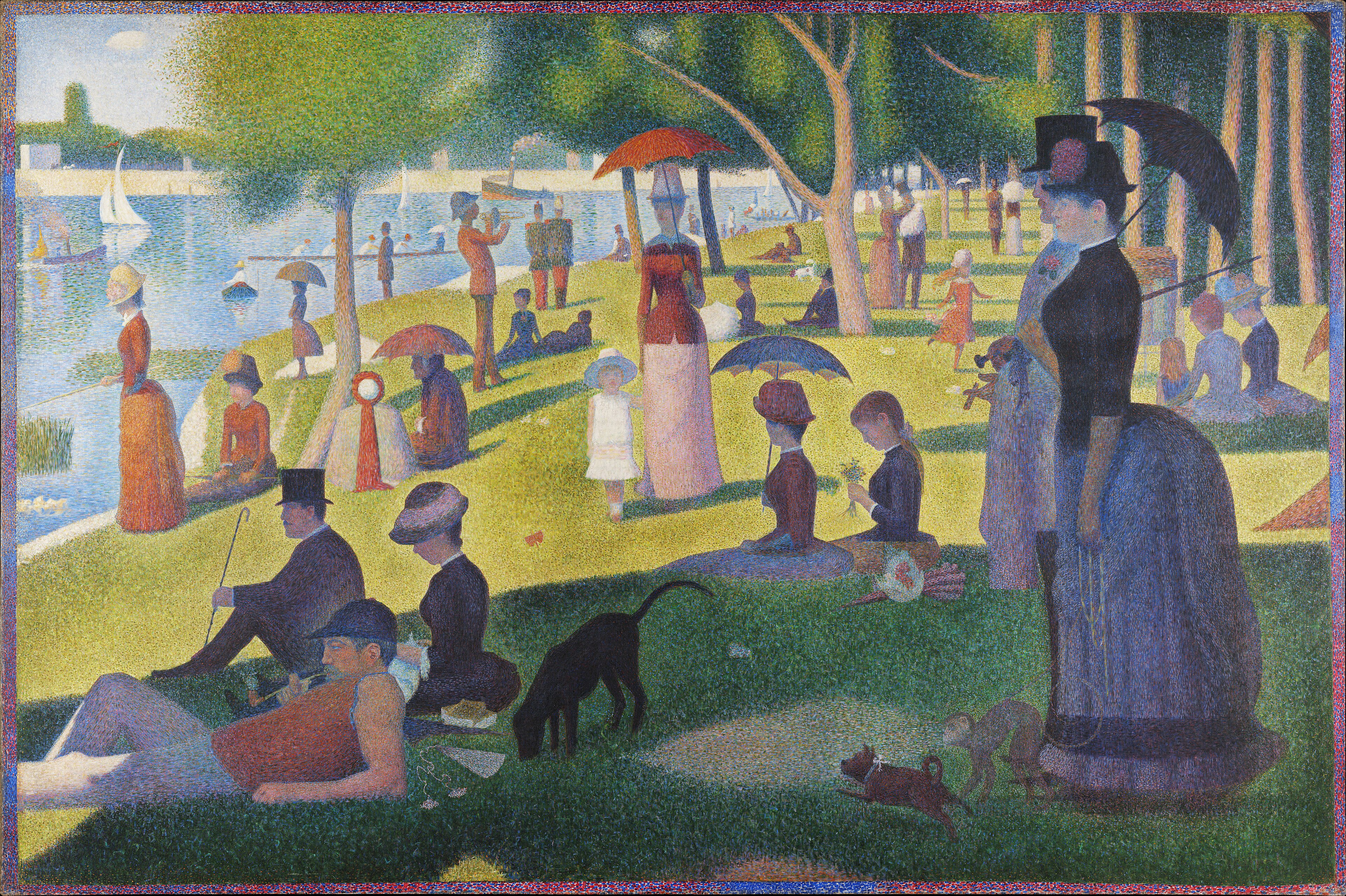
Then came the picture that made him famous and gave a movement its name. A Sunday on La Grande Jatte — 1884 took him two years and more than sixty preparatory studies. On a small island in the Seine, Parisians stroll, sit and fish in the afternoon sun, every figure simplified into a clean, almost geometric silhouette — a woman’s bustle, a parasol’s curve, a top hat’s cylinder. The whole scene is built from millions of tiny dots, and Seurat even extended the dotting onto the painted border and frame, so the light would not stop at the canvas edge. When it was shown in 1886 it bewildered and electrified viewers in equal measure; it is now the centrepiece of the Art Institute of Chicago and one of the most recognised paintings on earth. In works like Les Poseuses, he turned the same scientific eye inward, even placing La Grande Jatte itself on the studio wall behind his models.
위대한 일요일 오후
그리고 그를 유명하게 만들고 한 운동에 이름을 안긴 그림이 찾아왔다. 그랑드자트섬의 일요일 오후 — 1884는 2년의 시간과 예순 점이 넘는 준비 습작을 요구했다. 센강의 작은 섬에서 파리 사람들이 오후 햇살을 받으며 거닐고, 앉고, 낚시를 한다. 모든 인물은 깔끔하고 거의 기하학적인 실루엣으로 단순화되어 있다 — 여인의 버슬 치마, 양산의 곡선, 실크해트의 원통. 장면 전체가 수백만 개의 작은 점으로 지어졌고, 쇠라는 빛이 화폭 가장자리에서 멈추지 않도록 점묘를 채색된 테두리와 액자에까지 이어 갔다. 1886년 공개되었을 때 이 그림은 관객을 어리둥절하게 하는 동시에 전율케 했다. 지금은 시카고 미술관의 중심 작품이자 지구상에서 가장 널리 알려진 회화 중 하나다. 포즈를 취한 여인들 같은 작품에서 그는 같은 과학의 눈을 안으로 돌려, 모델들 뒤 작업실 벽에 그랑드자트섬 그 자체를 걸어 두기도 했다.
The Neo-Impressionist Circle
Seurat did not work in isolation. In 1884, frustrated by the official Salon, he helped found the Société des Artistes Indépendants, the jury-free exhibiting society where La Grande Jatte would cause its sensation. There he met Paul Signac, who became his closest ally and the movement’s tireless theorist; even the older Impressionist Camille Pissarro briefly took up the dotted technique. Critics named the new style Neo-Impressionism — a cooler, more deliberate, almost scientific answer to the warm spontaneity of Claude Monet and the first Impressionists. Where they had chased the fleeting impression of a moment, Seurat and his circle wanted to fix light in place by method, building a calm, lasting order out of pure colour.
신인상주의의 서클
쇠라는 홀로 작업하지 않았다. 1884년, 관전(官展) 살롱에 좌절한 그는 심사 없는 전시 단체인 ‘앵데팡당전(독립미술가협회)’의 창립을 도왔고, 그랑드자트섬은 바로 그곳에서 센세이션을 일으키게 된다. 그곳에서 그는 폴 시냐크를 만났는데, 시냐크는 그의 가장 가까운 동지이자 이 운동의 지칠 줄 모르는 이론가가 되었다. 나이 많은 인상주의자 카미유 피사로조차 잠시 이 점묘 기법을 받아들였다. 비평가들은 이 새로운 양식을 신인상주의라 불렀다 — 클로드 모네와 초기 인상주의자들의 따뜻한 즉흥성에 대한, 더 차갑고 더 의도적이며 거의 과학적인 응답이었다. 그들이 한순간의 덧없는 인상을 좇았다면, 쇠라와 그의 서클은 빛을 방법으로 붙들어, 순수한 색으로부터 고요하고 지속되는 질서를 쌓고자 했다.


A Short Life, a Long Shadow
Seurat’s last great canvases turned to artificial light and modern leisure — the electric glare of cabarets and circuses, with lines that lift and curl to suggest gaiety and movement. The Circus, with its acrobat and prancing horse, was still unfinished on his easel when he died suddenly in the spring of 1891, probably of an infectious illness, leaving a body of work astonishingly small for his fame: only a handful of monumental paintings. Yet his shadow is long. His broken colour fed directly into the explosive palettes of Van Gogh, Matisse and the Fauves, and his dream of building an image from discrete units of pure colour can feel uncannily modern today — every digital screen, after all, is a grid of tiny coloured dots resolving into a picture only at a distance. Seurat, it turns out, was painting in pixels a century before the word existed.
짧은 생애, 긴 그림자
쇠라의 마지막 대작들은 인공의 빛과 현대의 여가로 향했다 — 카바레와 서커스의 전기 불빛, 그리고 흥겨움과 움직임을 암시하며 들리고 휘어 오르는 선들. 곡예사와 뛰어오르는 말이 등장하는 서커스는 1891년 봄 그가 — 아마도 전염성 질환으로 — 갑작스레 세상을 떠났을 때 여전히 이젤 위에서 미완으로 남아 있었다. 그의 명성에 비하면 놀랄 만큼 적은 작품, 단 몇 점의 기념비적 회화만을 남긴 채로. 그러나 그의 그림자는 길다. 그의 분할된 색채는 반 고흐, 마티스, 그리고 야수파의 폭발적인 색면으로 곧장 흘러들었고, 순수한 색의 낱낱의 단위로 이미지를 쌓는다는 그의 꿈은 오늘날 기묘하리만치 현대적으로 다가온다 — 결국 모든 디지털 화면이란, 멀리서야 하나의 그림으로 맺히는 작은 색점들의 격자가 아닌가. 쇠라는, 알고 보면, ‘픽셀’이라는 말이 생기기 한 세기 전에 이미 픽셀로 그리고 있었던 셈이다.
Leave a Reply