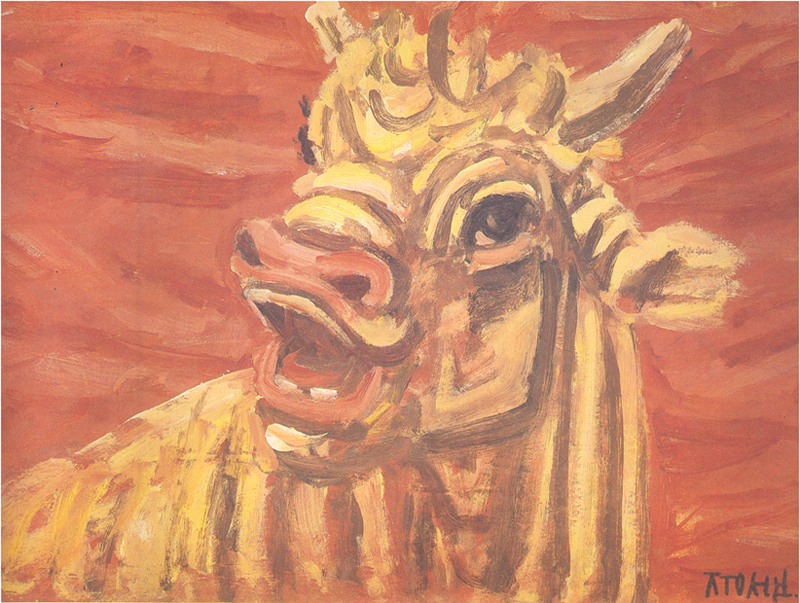


The Birth and Lonely Demise of the Bull
Lee Jung-seop, an artist whose story cannot be told without mentioning bulls, painted dynamic bulls with bold strokes and later, lonely and frail bulls. His affection and obsession with bulls, which were familiar to him from childhood, led him to create a wide array of bull paintings, each displaying his relentless pursuit of artistic exploration. Lee’s work spans diverse styles, making it difficult to recognize as the work of a single artist, showcasing his deep passion and curiosity for art. Beyond bulls, he also explored various themes such as paintings of groups of children, foil paintings (drawings etched on aluminum foil), and depictions reminiscent of his family.
Born in 1916 in Pyongwon, South Pyeongan Province (now North Korea), Lee was raised in a wealthy family that nurtured his early interest in art. He began drawing bulls during his time at Osan School and later, in his twenties, went to study art at Bunka Gakuin in Tokyo, Japan. During this period, he participated in various art competitions, submitting bull paintings in different styles. It was also during this time that he was profoundly influenced by Western art, particularly the works of Georges Rouault. Rouault’s use of thick, strong lines left a lasting impact on Lee’s art, which can be seen in his own works, resembling the techniques of traditional ink-wash painting. Additionally, Lee was inspired by the poetry of his senior at Osan School, the poet Baek Seok, leading him to create works that expressed poetry through painting.
소의 탄생과 고독한 소멸
힘이 넘치는 붓질로 역동적인 소를 그리던 이중섭, 그리고 고독하고 쇠약한 소를 그리던 그. 소를 빼놓고는 그의 이야기를 할 수 없는 한국의 예술가, 이중섭. 그는 어린 시절부터 친숙했던 소에 대한 애정과 집착으로 다양한 스타일의 소 그림을 남겼다. 이중섭의 작품은 한 사람의 작품으로 인식하기 어려울 정도로 다양한 방식으로 표현되어 있으며, 이는 그의 끊임없는 탐구 정신과 예술에 대한 열정을 드러낸다. 그는 소 외에도 군동화(아이들이 모여 있는 그림), 은지화(은박지에 새겨 그린 그림), 가족을 연상시키는 그림 등 여러 주제를 탐구하며 다채로운 작품 세계를 구축했다.
1916년 평안남도 평원(지금의 북한)에서 태어난 이중섭은 부유한 가정환경에서 자라면서 일찍이 미술에 대한 관심을 키웠다. 오산학교 시절부터 소를 그리기 시작한 그는, 20대에 일본 도쿄의 문화학원으로 유학을 떠나 본격적인 미술 공부를 시작했다. 유학 시절 이중섭은 다양한 공모전에 참여하며 서로 다른 양식의 소 그림을 출품했고, 이 과정에서 서양 미술의 영향을 깊이 받았다. 특히 조르주 루오의 작품에서 강한 영감을 얻었으며, 루오의 진한 윤곽과 강렬한 선은 이중섭의 그림에서도 찾아볼 수 있다. 이는 전통 수묵화의 느낌을 현대적으로 재해석한 그의 독창적 기법을 형성하는 데 중요한 역할을 했다. 또한, 오산학교의 선배이자 시인인 백석의 시에서도 깊은 영감을 받아, 시를 그림으로 표현하는 작업에도 몰두했다.


Family and the Motive of Life
In 1945, Lee Jung-seop married a Japanese woman, Yamamoto Masako, forming a family that would become a recurring theme of happiness in his art, though his real life was far from happy. With the outbreak of the Korean War in 1950, Lee fled to Jeju Island via Busan, where he lived in a small room with his wife and two sons for a year, continuing his artistic work despite the hardships. During this time, he sought to express not just the form of the bull but its inner strength and despair, increasingly identifying with the bull and projecting his emotions onto it. However, the harshness of their refugee life worsened as his wife developed tuberculosis and his two sons suffered from malnutrition, leading to their separation and Lee’s return to Busan alone.
While his wife and sons lived in Japan, Lee managed to visit them for just one week—a brief reunion that turned out to be their last. After this meeting, Lee threw himself back into his work with renewed determination, driven by the hope of reuniting with his family. His art from this period is filled with intense vitality and dynamism, reflecting his unyielding spirit. In these works, the bull becomes more than just an animal; it is a projection of Lee’s life struggles and emotions.
가족과 삶의 동기
1945년, 이중섭은 일본인 야마모토 마사코와 결혼하며 가족을 형성했다. 그의 작품에서 가족은 자주 행복한 대상으로 묘사되었으나, 실제 그의 삶은 그리 행복하지 않았다. 1950년 한국 전쟁이 발발하면서 이중섭은 부산을 거쳐 제주도로 피난을 떠났고, 1년간 제주도의 작은 방에서 아내와 두 아들과 생활하며 작품 활동을 이어갔다. 이 시기에 그는 소의 외형이 아닌 내면과 힘, 그리고 절망을 표현하고자 했으며, 점차 소와 자신을 동일시하면서 소에 자신의 감정을 투영하기 시작했다. 그러나 피난 생활의 고난은 계속되었고, 결국 아내의 폐결핵과 두 아들의 영양실조로 인해 가족과 헤어져 부산으로 홀로 돌아오게 되었다.
아내와 두 아들이 일본에서 생활하는 동안, 이중섭은 단 일주일간 일본을 방문할 수 있었으며, 이 짧은 만남이 가족들과의 마지막이 되었다. 이 만남 이후 그는 가족과 다시 함께 살겠다는 의지를 불태우며 작품 활동에 몰두하였다. 이 시기 그의 작품은 강렬한 동기 부여 속에 역동성과 생명력이 넘쳐났으며, 이는 소에 대한 그의 표현에서도 강하게 드러났다. 그의 작품 속 소는 단순한 동물이 아니라, 그가 겪은 삶의 역경과 감정의 투영체로서 그려졌다.


The Completion of the Bull and Loneliness
During this time, Lee believed that his depiction of the bull had reached its completion and he created several more works. However, his situation grew increasingly dire. Struggling financially, Lee produced numerous foil paintings, a unique technique where he would smooth out the foil from cigarette packs and use tools like matches to etch outlines, later rubbing dark paint over the foil to accentuate the lines. This technique emphasized the importance of lines, allowing powerful expression with minimal strokes. While foil paintings themselves received high acclaim, masterpieces like “Paradise” further elevated this medium. Three of his foil paintings were later acquired by the Museum of Modern Art (MoMA) in New York, making him the first Korean artist to have his work included in the museum’s collection. Sadly, Lee passed away before he could hear this joyous news.
In addition to foil paintings, Lee also drew pictures on letters to communicate with his family in Japan. Initially, these letters were filled with joyful depictions of people, but as his mental state deteriorated, the tone of his drawings darkened. By 1955, Lee stopped sending letters, even refusing to read those sent by his wife. His final bull paintings are imbued with melancholy, loneliness, and despair, reflecting the anguish of his final days. In 1956, having completed his life’s work, Lee Jung-seop passed away.
Viewing Lee Jung-seop’s works chronologically reveals the profound transformation in his life and art. His misfortune, ironically, propelled him to become one of the greatest artists of his time. Despite his short life of just 40 years, the originality and intensity of his works encompass his strong will, suffering, loss, and despair. Lee’s art goes beyond mere paintings; it serves as a mirror to his life, capturing the full range of his emotions in a solitary record of his existence.
소의 완성 그리고 외로움
이중섭은 이 시기부터 자신의 소 그림이 완성되었다고 믿었으며, 이에 다양한 작품을 그렸다. 그러나 그의 상황은 점점 더 어려워졌다. 경제적으로 궁핍한 상황에서 그는 수많은 은지화를 제작하였다. 은지화는 담뱃갑 속의 은박지 종이를 펼친 후, 성냥 같은 도구로 은박지를 눌러 윤곽선을 그린 뒤, 진한 색의 물감을 솜이나 헝겊으로 문질러 선을 도드라지게 하는 독창적인 방식으로 제작되었다. 이 방식은 선의 중요성을 강조하며, 적은 선으로 강렬한 이미지를 표현하는 것이 특징이다. 은지화 자체도 훌륭한 평가를 받았지만, “도원”과 같은 명작은 이 은지화를 바탕으로 더욱 발전된 작품으로 평가받고 있다. 그의 은지화 3점은 후에 뉴욕 현대미술관(MOMA)에서 소장하게 되었는데, 이는 한국인 작품으로는 처음 있는 일이었다. 그러나 이중섭은 이 기쁜 소식을 듣지 못한 채 세상을 떠났다.
은지화 외에도 그는 가족과의 연락을 위해 편지에 그림을 그리곤 했다. 초기에는 사람과 기쁨을 표현한 그림이 많았지만, 시간이 지나면서 그의 정신적 상태는 더욱 악화되었다. 1955년 이후로는 점차 가족에게 편지를 보내는 것을 중단하였고, 마지막 편지에는 침울함과 고독함, 그리고 좌절만이 가득했다. 이중섭의 마지막 소 그림들에는 이러한 감정들이 고스란히 담겨 있으며, 그는 결국 1956년, 생을 마감하였다.
이중섭의 작품을 시간 순으로 살펴보면, 그의 삶과 예술이 어떻게 변화했는지 명확히 드러난다. 그의 불행은 역설적으로 그를 당대 최고의 예술가로 만들었으며, 짧은 40년의 생이었지만 그가 남긴 독창적이고 강렬한 작품들은 그의 강한 의지, 고통, 상실, 그리고 좌절을 모두 아우르고 있다. 이중섭의 작품들은 단순한 미술 작품을 넘어, 그의 인생을 반영하는 거울이며, 그가 겪은 모든 감정을 담고 있는 고독한 기록이다.


- https://en.wikipedia.org/wiki/Lee_Jung-seob
- https://gongu.copyright.or.kr/gongu/wrt/wrt/view.do?wrtSn=9022679&menuNo=200018
Leave a Reply