

Louise Bourgeois: The Spider as a Portrait of Mother
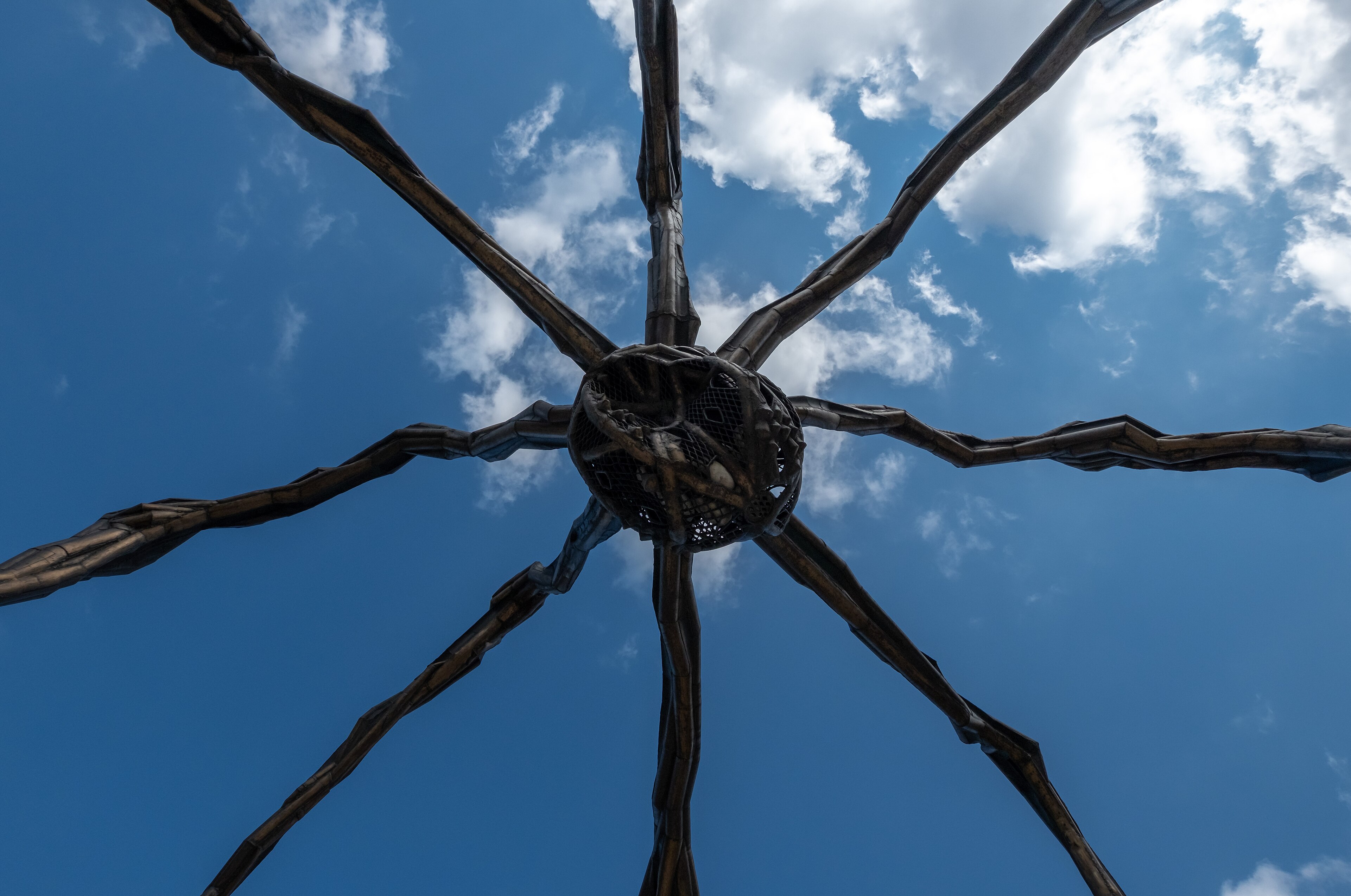
To stand beneath one of Louise Bourgeois’s giant spiders is a strange, double experience. From a distance the creature looks menacing — more than nine metres tall, its bronze legs arched like the ribs of a cathedral. Step underneath, and the menace softens into shelter; high in its belly hangs a sac of pale marble eggs, and you realise you are standing inside something protective rather than predatory. Bourgeois titled the work Maman — the tender French word for “mother” — and meant it as a portrait. “The Spider is an ode to my mother,” she wrote. “Like a spider, my mother was a weaver… spiders are helpful and protective, just like my mother.” Few artists have ever turned an image we instinctively fear into a monument of love this completely.
루이즈 부르주아: 어머니의 초상이 된 거미
루이즈 부르주아의 거대한 거미 아래에 서는 일은 묘하게도 두 겹의 경험이다. 멀리서 보면 그 생명체는 위협적이다 — 9미터가 넘는 키에, 청동 다리는 성당의 갈빗대처럼 휘어 있다. 그러나 그 아래로 걸어 들어가면 위협은 보호로 누그러진다. 배 높은 곳에 창백한 대리석 알들이 담긴 주머니가 매달려 있고, 당신은 포식이 아니라 비호(庇護)하는 무언가의 안에 서 있음을 깨닫는다. 부르주아는 이 작품에 ‘엄마’를 뜻하는 다정한 프랑스어 Maman이라는 제목을 붙였고, 그것을 하나의 초상으로 여겼다. “거미는 내 어머니에게 바치는 송가입니다.” 그녀는 썼다. “거미처럼, 내 어머니는 직조하는 사람이었어요… 거미는 이롭고 보호해 주는 존재예요, 꼭 내 어머니처럼.” 우리가 본능적으로 두려워하는 이미지를 이토록 완전하게 사랑의 기념비로 바꾸어 놓은 예술가는 드물다.

A Childhood Woven into the Work
The spider’s logic only makes sense through Bourgeois’s life. She was born in Paris on Christmas Day, 1911, into a family that restored antique tapestries; her mother, Joséphine, ran the workshop, and young Louise grew up drawing in the missing sections of worn fabric so they could be rewoven. Weaving, mending, repairing — these were the gestures of her mother, and they became the deep grammar of her art. But the home held wounds too. Her father carried on a long affair with the family’s live-in English tutor, a betrayal Bourgeois never forgot; when she was twenty-one her mother died, and in her grief she threw herself into a river, from which her father pulled her out. Decades later she would say that art was her way of re-experiencing the past in order to survive it — “a guarantee of sanity.”
작품 속에 짜여 들어간 유년
거미의 논리는 부르주아의 삶을 통해서만 이해된다. 그녀는 1911년 크리스마스에 파리에서, 고(古)태피스트리를 복원하는 집안에서 태어났다. 어머니 조제핀이 공방을 운영했고, 어린 루이즈는 닳아 사라진 천 조각의 빈 부분을 그려 넣어 다시 짜 넣을 수 있도록 도왔다. 짜고, 깁고, 고치는 일 — 그것은 어머니의 몸짓이었고, 훗날 그녀 예술의 깊은 문법이 되었다. 그러나 그 집에는 상처도 있었다. 아버지는 집에 함께 살던 영국인 가정교사와 오랜 불륜을 이어갔고, 부르주아는 그 배신을 결코 잊지 못했다. 그녀가 스물한 살이 되던 해 어머니가 세상을 떠났고, 슬픔에 잠긴 그녀는 강에 몸을 던졌다가 아버지에게 구조되었다. 수십 년 뒤 그녀는 예술이란 살아남기 위해 과거를 다시 겪어내는 자신만의 방식이라고, “온전한 정신을 지키는 보증서”라고 말하곤 했다.


Maman Around the World
Maman was first unveiled in 2000 for the inaugural Unilever commission in the vast Turbine Hall of London’s Tate Modern. The original was made in steel; six more were later cast in bronze, marble and stainless steel, each rising more than ten metres and cradling thirty-two marble eggs. Those castings now stand guard at some of the most-photographed museums on earth — the Guggenheim in Bilbao, the National Gallery of Canada in Ottawa (bought in 2005 for 3.2 million dollars), the foot of Mori Tower in Tokyo’s Roppongi Hills, and the Leeum Museum in Seoul, with the steel original held by Tate. Wherever it travels, the spider performs the same quiet trick: it makes a public plaza feel suddenly intimate, as though the whole city had wandered in under its mother’s body.
세계 곳곳의 마망
Maman은 2000년 런던 테이트 모던의 광활한 터빈 홀에서 열린 첫 유니레버 커미션을 위해 처음 공개되었다. 원작은 강철로 제작되었고, 이후 청동·대리석·스테인리스강으로 여섯 점이 더 주조되었다. 각각은 10미터가 넘는 키에 서른두 개의 대리석 알을 품고 있다. 이 주조본들은 지금 지구상에서 가장 많이 사진에 찍히는 미술관들을 지키고 서 있다 — 빌바오 구겐하임, 오타와의 캐나다 국립미술관(2005년 320만 달러에 구입), 도쿄 롯폰기힐스 모리타워 아래, 그리고 서울의 리움미술관. 강철 원작은 테이트가 소장하고 있다. 어디로 옮겨가든 거미는 같은 조용한 마술을 부린다. 공공 광장을 돌연 친밀한 공간으로 바꾸어, 마치 도시 전체가 어머니의 몸 아래로 걸어 들어온 듯한 느낌을 자아내는 것이다.
.jpg?width=1600)

From Femme Maison to Confession
Long before the spiders, Louise Bourgeois was a sculptor’s sculptor in New York. In the 1940s she painted the eerie Femme Maison (“woman-house”) series — figures whose heads and torsos are swallowed by the houses they inhabit, women fused with and trapped by domestic space. Three decades later her 1974 installation The Destruction of the Father staged a child’s revenge fantasy as a dim, cave-like chamber of bulbous forms, a tableau of the dinner-table tyrant of her youth devoured by his own family. Across all of it she treated art as confession, turning private wounds into shared form. By the time the spiders made her famous she had quietly earned a place among the major sculptors of her adopted city — a lineage running from Constantin Brâncuși through Alexander Calder and Richard Serra — yet her work stayed stubbornly personal where theirs turned toward abstraction or sheer scale.
여인-집에서 고백으로
거미들이 나오기 훨씬 전, 루이즈 부르주아는 뉴욕에서 ‘조각가들의 조각가’였다. 1940년대에 그녀는 으스스한 여인-집(Femme Maison) 연작을 그렸다 — 머리와 몸통이 자신이 깃든 집에 삼켜진 형상들, 가정의 공간과 한 몸이 되어 그 안에 갇힌 여인들. 그로부터 30년 뒤인 1974년의 설치작 아버지의 파괴(The Destruction of the Father)는, 어둑한 동굴 같은 방을 불룩한 형상들로 채워 아이의 복수 환상을 무대에 올렸다. 유년의 식탁을 지배하던 폭군이 제 가족에게 잡아먹히는 장면이었다. 그 모든 작업에서 그녀는 예술을 고백으로 다루며, 사적인 상처를 함께 나눌 형태로 바꾸어 놓았다. 거미들이 그녀를 유명하게 만들 무렵, 그녀는 이미 자신이 택한 도시의 주요 조각가들 사이에 조용히 자리를 얻은 상태였다 — 콘스탄틴 브랑쿠시에서 알렉산더 칼더와 리차드 세라로 이어지는 계보. 그러나 그들이 추상이나 순수한 규모로 향한 자리에서, 그녀의 작업은 고집스럽게 사적인 채로 남았다.

The Cells, and a Late Blooming
The spiders are only one chapter. From 1989 Bourgeois built a series of room-sized installations she called Cells — caged enclosures stitched together from old doors, mirrors, glass spheres, fragments of tapestry and worn personal objects, each one a container of memory you can almost step into. What makes her story remarkable is how late the recognition came. She had worked quietly for half a century when, in 1982, the Museum of Modern Art gave her a full retrospective — its first ever devoted to a woman artist — and she was already seventy. She kept making art almost daily until her death in New York in 2010, at ninety-eight. Her great subject never changed: the family, the body, memory, the unbearable closeness of love and fear. The spider simply gave it eight legs and let it stand over us.
셀, 그리고 뒤늦게 핀 꽃
거미는 한 장(章)에 불과하다. 1989년부터 부르주아는 셀(Cells)이라 부른 방 크기의 설치 연작을 지어 올렸다 — 낡은 문, 거울, 유리 구, 태피스트리 조각, 손때 묻은 개인 물건들을 엮어 만든 우리(籠) 형태의 공간으로, 하나하나가 걸어 들어갈 수 있을 듯한 기억의 그릇이었다. 그녀의 이야기에서 무엇보다 놀라운 점은, 인정이 그토록 뒤늦게 찾아왔다는 사실이다. 반세기 동안 조용히 작업해 온 그녀에게 1982년 뉴욕 현대미술관(MoMA)이 회고전을 열어주었는데 — 여성 작가에게 헌정된 최초의 회고전이었다 — 그때 그녀는 이미 일흔이었다. 그녀는 2010년 아흔여덟의 나이로 뉴욕에서 세상을 떠나기까지 거의 매일 작업을 멈추지 않았다. 그녀의 큰 주제는 끝내 변하지 않았다. 가족, 몸, 기억, 그리고 견딜 수 없이 가까운 사랑과 두려움. 거미는 다만 거기에 여덟 개의 다리를 달아, 그것이 우리 위에 우뚝 서게 했을 뿐이다.
Rights note: the photographs are openly licensed, but the Maman sculpture itself remains under copyright (The Easton Foundation). These are outdoor public-display photos reused under freedom-of-panorama in Spain, Canada and Brazil; confirm for any other commercial context.
Leave a Reply