
Cubeworks: One Cube, Endless Variations
I gave myself the strictest possible starting point: a single cube. No story, no figure, no scene — just six square faces and the rule that everything had to grow out of that one form. Cubeworks is the series that came from refusing to leave it alone. Each piece takes the same humble box and asks one question of it — what if I clad it, hollow it, weave it, let it ripple or come apart? — and lets the answer become the whole image. Working between Rhino, Grasshopper and a painter’s instinct for colour and ground, I treat the cube less as an object and more as a grammar: a small set of rules I can bend until the most ordinary shape in geometry starts to surprise me. The grid above is a glimpse of how far that one box has travelled. If you’ve seen my Something Big Object miniature monuments, my PastelScape dream-worlds, or my Voxelized Emotions terrains, this is the same rule-driven, generative curiosity pointed at a single shape.
큐브웍스: 하나의 정육면체, 무한한 변주
나는 스스로에게 가장 엄격한 출발점을 주었다. 단 하나의 정육면체. 이야기도, 인물도, 장면도 없이 — 여섯 개의 정사각형 면, 그리고 모든 것이 그 하나의 형태에서 자라나야 한다는 규칙뿐. Cubeworks는 그 정육면체를 가만히 내버려 두기를 거부하며 태어난 시리즈다. 각 작품은 똑같은 소박한 상자를 두고 하나의 질문을 던진다 — 겉을 입히면? 속을 비우면? 엮으면? 물결치게 하거나 해체하면? — 그리고 그 답이 화면 전체가 되도록 둔다. 라이노와 그래스호퍼, 그리고 색과 바탕에 대한 화가의 직관 사이를 오가며, 나는 정육면체를 사물이라기보다 하나의 문법으로 다룬다. 기하학에서 가장 평범한 형태가 나를 놀라게 하기 시작할 때까지 구부려 볼 수 있는, 작은 규칙들의 집합으로. 위의 그리드는 그 하나의 상자가 얼마나 멀리까지 왔는지를 보여 주는 한 조각이다. 내 Something Big Object 미니어처 기념비, PastelScape 꿈의 세계, 혹은 복셀라이즈드 이모션 지형을 본 적이 있다면, 이것은 같은 규칙 기반의 생성적 호기심을 단 하나의 형태로 겨눈 것이다.


Adding to the Cube, and Cutting into It
The two simplest things I can do to a cube are pile onto it and carve out of it, and the series keeps returning to both. Tetris Cubes clads the form in a rugged skin of small protruding blocks in deep forest green, the relief clustering thickly like moss creeping over masonry until the box feels half-reclaimed by its own pixelated vegetation. Boolean Pipe Cube does the opposite: a single generous cylinder tunnels clean through a pale blue mass, its smooth hole lined with a glowing orange interior. One adds until the surface turns craggy and alive; the other subtracts just once, but boldly, so the whole piece becomes about passage and depth. Put side by side, they map the two poles the rest of the series moves between.
정육면체에 더하기, 그리고 깎아 내기
정육면체에 할 수 있는 가장 단순한 두 가지는 그 위에 쌓는 것과 그것을 파내는 것이고, 이 시리즈는 그 둘로 계속 되돌아온다. Tetris Cubes는 형태에 작은 돌출 블록들의 거친 살갗을 입힌다. 짙은 숲빛 초록의 부조가 마치 석조 위로 번지는 이끼처럼 두텁게 뭉치며, 상자는 제 픽셀화된 식생에 절반쯤 잠식된 듯 보인다. Boolean Pipe Cube는 그 반대다. 하나의 넉넉한 원통이 옅은 푸른 덩어리를 깨끗이 관통하고, 그 매끄러운 구멍은 빛나는 주황빛 내부로 둘러져 있다. 하나는 표면이 울퉁불퉁 살아날 때까지 더하고, 다른 하나는 단 한 번, 그러나 과감하게 덜어내어 작품 전체가 통로와 깊이에 관한 것이 되게 한다. 나란히 두면, 둘은 이 시리즈의 나머지가 오가는 두 극을 그려 낸다.


The Logic of Subdivision and Pattern
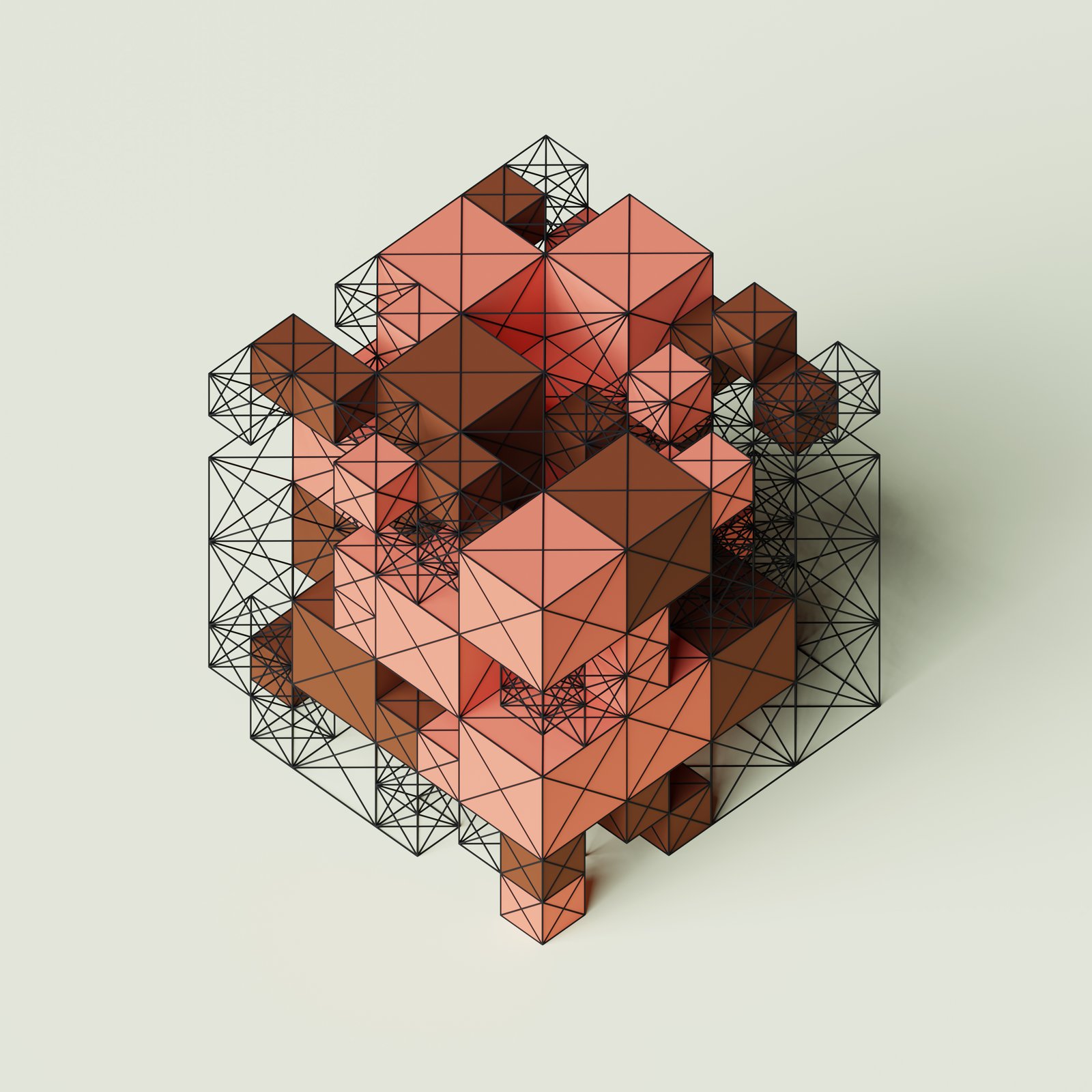
Some pieces are really diagrams of their own rules. Octree Cubes splits a red mass into nested cells, pairing solid sub-cubes with the fine wireframe of their own subdivision, so the cube looks caught mid-construction — a model showing its working. Truchet Pattern Cube wraps the form in a maze of rounded interlocking lines that wander continuously across every face, a single tiling rule joining into endless looping channels. I love how these two hold opposite temperatures of the same idea: subdivision is structural and architectural, all scaffolding and nesting, while the Truchet wrap is decorative and restless, a puzzle whose paths never quite resolve. Both prove that you don’t need to add colour or mass to transform a cube — sometimes a rule is enough.
분할과 패턴의 논리
어떤 작품들은 사실 자기 규칙의 다이어그램이다. Octree Cubes는 붉은 덩어리를 중첩된 세포들로 쪼개며, 단단한 하위 정육면체들을 그것이 나뉘는 가는 와이어프레임과 짝지어, 정육면체가 한창 지어지는 중에 붙잡힌 듯 보이게 한다 — 제 작동 원리를 드러내는 모형처럼. Truchet Pattern Cube는 형태를 둥글게 맞물리는 선들의 미로로 감싼다. 모든 면을 연속으로 떠도는 그 선들은 하나의 타일링 규칙이 끝없는 고리의 채널로 이어진 것이다. 나는 이 둘이 같은 발상의 정반대 온도를 품는 방식이 좋다. 분할은 구조적이고 건축적이어서 온통 골조와 중첩이고, 트루셰 감싸기는 장식적이고 가만있지 못해, 그 길들이 끝내 풀리지 않는 퍼즐이 된다. 둘 다, 정육면체를 변형하는 데 색이나 질량을 더할 필요가 없음을 증명한다 — 때로는 규칙 하나면 충분하다.


Soft Holes and Hollow Cores
Subtraction doesn’t have to be sharp. Boolean Operation Cube rounds the boolean language into something almost confectionary: a white cube carved with soft pastel blob cavities — mint, pink and lemon — scooped into its faces while the edges stay crisp, the whole thing gentle against a lilac ground. Negative Cutout Cube takes the same instinct somewhere colder and stranger, opening a gridded shell to reveal a hollow black core, a porous frame wrapped around nothing but shadow. One makes emptiness sweet, the other makes it cavernous. I keep coming back to the void as a material in its own right — the cube is often most interesting where it isn’t there at all.
부드러운 구멍과 텅 빈 속
빼기가 꼭 날카로울 필요는 없다. Boolean Operation Cube는 불리언의 언어를 거의 과자 같은 무언가로 둥글린다. 흰 정육면체의 면들에 민트·핑크·레몬빛의 부드러운 방울 모양 공동이 떠내어지고, 모서리는 또렷하게 남은 채, 전체가 라일락 바탕 위에서 온화하다. Negative Cutout Cube는 같은 직관을 더 차갑고 기이한 곳으로 데려가, 격자 껍질을 열어 텅 빈 검은 속을 드러낸다. 그림자 외에는 아무것도 감싸지 않은 다공질의 틀. 하나는 비어 있음을 달콤하게, 다른 하나는 동굴처럼 만든다. 나는 보이드를 그 자체로 하나의 재료로 자꾸 되돌아본다 — 정육면체는 종종 그것이 아예 존재하지 않는 자리에서 가장 흥미롭다.


When the Surface Starts to Move
A cube is so still that the smallest hint of motion reads as a small miracle. Ripple Cube lets a floral, organic pattern blossom across every blue face, looping shapes that read like a field of stylised flowers giving the rigid form a gentle, decorative drift. Snake Cube threads soft pastel tubes through a cube frame in a single continuous snaking path, the channel folding back on itself to fill the volume like one pipe routed through a puzzle. Neither breaks the cube; they just set something flowing inside it. After so many pieces about structure and subtraction, these are the ones that feel almost animate — geometry caught in the middle of a slow, fluid gesture.
표면이 움직이기 시작할 때
정육면체는 너무도 고요해서, 아주 작은 움직임의 기미조차 작은 기적처럼 읽힌다. Ripple Cube는 꽃 같은 유기적 패턴이 모든 푸른 면 위로 피어나게 둔다. 양식화된 꽃밭처럼 읽히는 고리진 형상들이 단단한 형태에 부드럽고 장식적인 흐름을 부여한다. Snake Cube는 부드러운 파스텔 튜브를 정육면체 프레임 사이로 하나의 연속된 뱀 같은 경로로 꿴다. 그 통로는 자기 위로 되접히며, 퍼즐을 통해 배관된 하나의 파이프처럼 부피를 채운다. 둘 다 정육면체를 부수지 않는다. 그저 그 안에 무언가가 흐르게 할 뿐이다. 구조와 빼기에 관한 그 많은 작품들 끝에, 이 둘은 거의 살아 있는 듯 느껴진다 — 느리고 유연한 몸짓의 한가운데 붙잡힌 기하학.


A Family of Variations
Cube with Holes is one of my favourite quiet ones: a navy cube drilled with round openings of varying size, scattered unevenly like the pores of a sponge or aged stone, the orange ground heightening the moody contrast. On its own it is a simple study in erosion — solid mass slowly opening into void — but it belongs to a much larger family, which is really the point of the second grid here. Lined up together, the pieces stop being individual experiments and become a kind of vocabulary: relief and hollow, pattern and frame, the sharp and the soft, all spoken in the same six-sided language. Seeing them side by side is how I check whether the series still holds together — and it does, precisely because every piece is so obviously a variation on the same stubborn box.
변주들의 한 가족
Cube with Holes는 내가 아끼는 조용한 작품 중 하나다. 짙은 남빛 정육면체에 크기가 제각각인 둥근 구멍들이 뚫려, 스펀지나 풍화된 돌의 기공처럼 고르지 않게 흩어지고, 주황 바탕이 그 가라앉은 대비를 끌어올린다. 그 자체로는 침식에 관한 단순한 연구—단단한 덩어리가 천천히 보이드로 열리는—이지만, 그것은 훨씬 큰 가족에 속하며, 그것이 여기 두 번째 그리드의 핵심이다. 한데 늘어놓으면 작품들은 더 이상 개별 실험이기를 멈추고 일종의 어휘가 된다. 부조와 빈 속, 패턴과 틀, 날카로운 것과 부드러운 것이 모두 같은 여섯 면의 언어로 발화된다. 나란히 보는 것은 이 시리즈가 여전히 하나로 맞물리는지 점검하는 방식이고 — 실제로 맞물린다. 바로, 모든 작품이 너무도 분명하게 같은 고집스러운 상자의 변주이기 때문이다.


An Open Series
I like to end on the cube refusing to settle. Stripe Cube nests concentric blue squares stepping inward on every face — a calm, monochrome cousin of the op-art pieces, letting pure geometry carry the eye toward each centre. Rolling Cube peels its black corners back like opening foil, pale undersides hinting at a secret interior. And Incomplete Cube is barely there at all: a form drawn in green and blue lines with several edges missing, a cube the eye has to finish for itself. That last one is the truest to how the whole project feels to make — always a few edges short of resolved, always one more question about the same box waiting to be answered. Cubeworks stays open; I’ll keep returning to that single cube for as long as it keeps surprising me.
열린 시리즈
나는 정육면체가 좀처럼 가라앉기를 거부하는 모습으로 끝맺기를 좋아한다. Stripe Cube는 동심의 푸른 사각형들을 모든 면에서 안쪽으로 한 단씩 포개다. 옵아트 작품들의 차분하고 단색인 사촌으로, 순수한 기하학만으로 시선을 각 중심으로 이끈다. Rolling Cube는 검은 모서리를 호일처럼 벗겨 올리며, 창백한 안쪽으로 비밀스러운 내부를 암시한다. 그리고 Incomplete Cube는 거의 존재하지도 않는다. 초록과 파랑 선으로 그려지되 여러 모서리가 빠진 형태, 보는 사람의 눈이 스스로 완성해야 하는 정육면체다. 그 마지막 작품은 이 프로젝트 전체를 만드는 느낌에 가장 충실하다 — 늘 몇 모서리쯤 미해결인 채로, 늘 같은 상자에 대한 또 하나의 질문이 답을 기다리는 채로. Cubeworks는 열린 채로 남는다. 그 하나의 정육면체가 나를 놀라게 하는 한, 나는 계속 그리로 돌아갈 것이다.

Image Credits / 이미지 출처
All images are original works by JuneLeeDesign (Junghyo Lee), from the Cubeworks series — © the artist, used by permission. Source: junghyolee.com/cubearchive. Pieces shown include the two compilation grids (hero and “A Family of Variations”) plus Tetris Cubes, Boolean Pipe Cube, Octree Cubes, Truchet Pattern Cube, Boolean Operation Cube, Negative Cutout Cube, Ripple Cube, Snake Cube, Cube with Holes, Stripe Cube, Rolling Cube and Incomplete Cube — each on its piece page at junghyolee.com.
Leave a Reply