

Giuseppe Arcimboldo: Portraits Made of Fruit and Fish
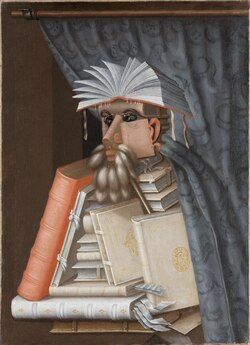
Some artists ask you to look closely; Giuseppe Arcimboldo (c. 1526–1593) asks you to look twice. Born in Milan to a family of painters, he began his career conventionally enough, designing stained glass for the city’s cathedral and frescoes for churches in Lombardy. But in 1562 he was summoned to the Habsburg court in Vienna, and later Prague, where as court portraitist to three successive emperors he invented something the history of art had never quite seen before: human faces assembled entirely out of fruit, flowers, fish, books, and roasted game. From a distance you read a dignified profile. Step closer and the cheek dissolves into a ripe peach, the nose becomes a pear, the eyebrow a sheaf of wheat. It is portraiture and still life folded into a single, witty image.
주세페 아르침볼도: 과일과 물고기로 그린 초상
어떤 화가는 자세히 들여다보라 청하지만, 주세페 아르침볼도(c. 1526–1593)는 두 번 보라고 청한다. 밀라노의 화가 집안에서 태어난 그는 처음에는 평범하게 출발했다. 1562년 빈의 합스부르크 궁정으로, 이후 프라하로 부름을 받으면서, 세 명의 황제를 잇따라 모신 궁정 초상화가로서 미술사가 일찍이 본 적 없는 것을 창안했다. 멀리서 보면 품위 있는 옆얼굴이 읽힌다. 가까이 다가서면 볼은 잘 익은 복숭아로, 코는 배로, 눈썹은 한 줌의 밀 이삭으로 흩어진다. 초상화와 정물화가 재치 있는 하나의 이미지로 접혀 든 것이다.


The Four Seasons and the Four Elements
Arcimboldo’s most beloved works belong to two great cycles. The Four Seasons (begun 1563) personifies spring, summer, autumn, and winter as composite heads built from each season’s harvest — Summer bursts with cherries, plums, and a cucumber nose, even weaving the artist’s name into the collar of straw. Its companion series, The Four Elements, conjures air from birds, fire from flints and candles, earth from animals, and water from a teeming reef of crabs, shells, and fish. Presented together at court, the two cycles formed an elaborate compliment to the Holy Roman Emperor: just as the seasons and elements bend to a natural order, so the empire would flourish in harmony under Habsburg rule. Beneath the whimsy lay a serious piece of political flattery.
사계절과 사원소
아르침볼도의 가장 사랑받는 작품은 두 개의 거대한 연작에 속한다. 1563년에 시작된 《사계절》은 봄·여름·가을·겨울을 각 계절의 수확물로 조립한 합성 두상으로 의인화한다. 《여름》은 체리와 자두로 가득 차고 오이로 된 코를 달았으며, 짚으로 엮은 옷깃에는 화가의 이름까지 짜 넣었다. 짝을 이루는 연작 《사원소》는 새들로 공기를, 부싯돌과 촛불로 불을, 동물들로 흙을, 게와 조개와 물고기가 빼곡한 암초로 물을 빚어낸다. 궁정에서 함께 선보인 두 연작은 신성 로마 황제를 향한 정교한 찬사였다. 계절과 원소가 자연의 질서에 순응하듯, 제국 또한 합스부르크의 통치 아래 조화롭게 번영하리라는 것이다. 기발함 아래에는 진지한 정치적 헌사가 깔려 있었다.


Wit, Science, and the Wonder-Cabinet
It would be a mistake to read Arcimboldo as mere novelty. The Prague court of Rudolf II was a hothouse of curiosity — a place of astronomers, alchemists, and Wunderkammern crammed with exotic specimens — and Arcimboldo was very much part of that intellectual ferment. His tumbling abundance of plants and creatures reflects a genuine Renaissance appetite to catalog the natural world; scholars have identified dozens of botanically accurate species packed into a single head. He also served as court impresario, designing costumes, festivals, and mechanical devices. His composite portraits sit at the exact meeting point of art and science: playful riddles that are also careful observations, asking how many small truths it takes to add up to a likeness.
재치, 과학, 그리고 경이의 방
아르침볼도를 단순한 진기함으로만 읽는다면 그것은 오해다. 루돌프 2세의 프라하 궁정은 호기심의 온실이었다. 천문학자와 연금술사가 드나들고, 진귀한 표본으로 가득 찬 ‘분더카머(경이의 방)’가 있던 곳이며, 아르침볼도 역시 그 지적 발효의 한복판에 있었다. 쏟아질 듯 풍성한 식물과 생물은 자연 세계를 분류하려는 르네상스의 진정한 욕구를 반영한다. 그는 또한 궁정의 연출가로서 의상과 축제, 기계 장치를 도안하기도 했다. 그의 합성 초상은 예술과 과학이 정확히 만나는 지점에 놓여 있다. 장난스러운 수수께끼이자 세심한 관찰이며, 하나의 닮은꼴을 이루기 위해 얼마나 많은 작은 진실이 필요한가를 묻는다.


Reversible Heads and a Rediscovered Modernist
Arcimboldo also loved a pure visual joke. Several of his pictures are reversible: hang The Vegetable Gardener one way and you see a plain bowl of onions and cabbages; rotate it and the vegetables resolve into the grinning face of a gardener. These upside-down paintings were treasured as after-dinner entertainments at court. Yet they were more than parlour tricks — like the elongated figures of Mannerist contemporaries such as El Greco, they pushed against the calm certainties of the High Renaissance, insisting that how we see is as constructed and slippery as what we see. For a long time after his death Arcimboldo slipped into obscurity. Then the twentieth century found him again. The Surrealists — Salvador Dalí above all — claimed him as a spiritual ancestor, recognizing in his double images the same delight in metamorphosis and the uncanny that drove their own work.
뒤집히는 머리와 네 세기 앞선 모더니스트
아르침볼도는 순수한 시각적 농담도 사랑했다. 그의 그림 몇 점은 뒤집을 수 있다. 채소 기르는 사람을 한 방향으로 걸면 양파와 양배추가 담긴 평범한 금속 그릇이 보이지만, 거꾸로 돌리면 같은 채소들이 그릇 밖으로 씩 웃는 불그레한 정원사의 얼굴로 맺힌다. 이 거꾸로 된 그림들은 궁정에서 식후의 여흥으로 귀하게 여겨져, 사람들 사이로 돌아가며 회전시켜 탄성을 자아냈다. 그러나 그것들은 한낱 응접실의 눈속임 이상이었다 — 엘 그레코 같은 동시대 매너리즘 화가들의 길게 늘인 불안한 인물들이 그러했듯, 그것들은 전성기 르네상스의 차분한 확신에 맞서며, 어떻게 보는가가 무엇을 보는가만큼이나 구성되고 미끄러운 것임을 역설했다. 세상을 떠난 뒤 오랫동안 아르침볼도는 잊혔다. 그러다 20세기가 그를 다시 발견했다. 초현실주의자들, 무엇보다 살바도르 달리는 그를 정신적 선조로 받아들였다.
Leave a Reply