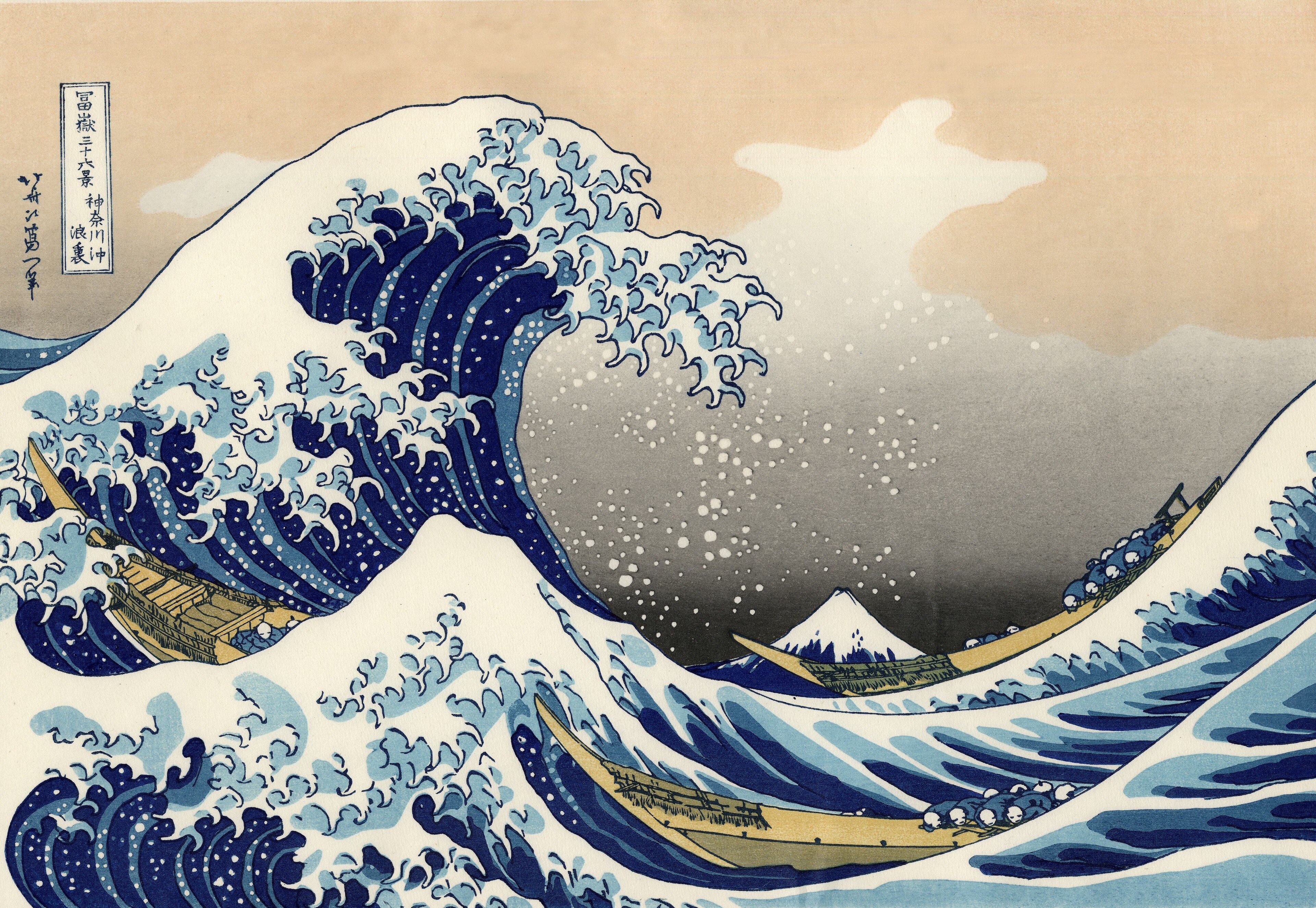


Katsushika Hokusai and The Great Wave off Kanagawa
There may be no single image in the history of art more widely recognised than The Great Wave off Kanagawa, and the artist who made it, Katsushika Hokusai, spent a lifetime earning that moment. Created around 1831, when he was already past seventy, the print shows a colossal wave rearing up over three slender fishing boats, its crest splintering into white claws that seem to reach for the men crouched helplessly inside. Far in the distance, dwarfed by the curling water yet utterly serene, sits the snow-capped cone of Mount Fuji. In a single composition Hokusai balances terror and calm, the violence of the sea against the stillness of the sacred mountain, the fleeting instant against the eternal. It is at once a Japanese woodblock print rooted in the popular ukiyo-e tradition and a piece of design so bold and graphic that it still looks startlingly modern nearly two centuries later.
가쓰시카 호쿠사이와 가나가와 해변의 큰 파도
미술의 역사를 통틀어 가나가와 해변의 큰 파도보다 더 널리 알려진 단 하나의 이미지는 없을지도 모르며, 그것을 만든 화가 가쓰시카 호쿠사이는 그 순간에 이르기까지 평생을 바쳤다. 그가 이미 일흔을 넘긴 1831년 무렵에 제작된 이 판화는, 가느다란 세 척의 고깃배 위로 우뚝 솟구치는 거대한 파도를 보여 준다. 그 마루는 하얀 발톱들로 부서지며, 배 안에 속절없이 웅크린 사내들을 향해 손을 뻗치는 듯하다. 저 멀리, 굽이치는 물결에 한없이 작아졌으면서도 더없이 고요한 자리에, 눈 덮인 후지산의 원뿔이 앉아 있다. 호쿠사이는 하나의 구성 안에서 공포와 평온을, 바다의 폭력과 신령한 산의 정적을, 찰나와 영원을 함께 저울질한다. 그것은 대중적 우키요에 전통에 뿌리내린 일본 목판화이면서, 동시에 두 세기가 다 되어 가는 지금도 놀랍도록 현대적으로 보이는, 대담하고 그래픽한 디자인의 한 점이다.

_-_Google_Art_Project.jpg)
Thirty-six Views of Mount Fuji
The Great Wave was never meant to stand alone. It opens a celebrated series, Thirty-six Views of Mount Fuji, in which Hokusai circles the sacred peak again and again, showing it through every season, weather and angle, glimpsed past carpenters, fishermen, travellers and trees. In Fine Wind, Clear Morning — affectionately known as “Red Fuji” — the mountain fills the frame almost as pure abstraction, its bare slope flushed russet by the dawn light beneath a sky of trailing clouds. The series was a commercial gamble that paid off spectacularly, riding a craze for Fuji pilgrimage and the arrival of a brilliant new imported pigment, Prussian blue, whose deep synthetic tone gave the prints their unmistakable cool intensity. So popular were the designs that the publisher added ten more views, stretching the “thirty-six” to forty-six, and turning a mountain into the most famous recurring subject in Japanese art.
후지산 36경
큰 파도는 결코 홀로 서기 위한 것이 아니었다. 그것은 이름 높은 연작 후지산 36경의 문을 여는 작품으로, 그 안에서 호쿠사이는 신령한 봉우리를 몇 번이고 에워싸며, 사계절과 온갖 날씨와 모든 각도에서, 목수와 어부와 나그네와 나무들 너머로 언뜻언뜻 그것을 보여 준다. 맑은 아침의 산들바람 — 다정하게 ‘붉은 후지’라 불리는 — 에서 산은 거의 순수한 추상처럼 화면을 가득 채우고, 헐벗은 비탈은 흐르는 구름의 하늘 아래 새벽빛에 적갈색으로 물든다. 이 연작은 상업적 도박이었으나 눈부시게 성공했다. 후지산 순례 열풍과, 새로 수입된 빼어난 안료 프러시안 블루의 등장에 올라탄 덕이었으니, 그 깊은 합성 빛깔이 판화들에 그 잊을 수 없는 서늘한 강렬함을 주었다. 디자인이 어찌나 인기였던지 판원은 열 점의 풍경을 더 보태어 ’36’을 마흔여섯으로 늘렸고, 하나의 산을 일본 미술에서 가장 유명한 반복 주제로 만들었다.

.jpg)
A Designer’s Eye: Geometry, Line, and Blue
What makes Hokusai feel so contemporary is the sheer design intelligence underlying every print. In Kajikazawa in Kai Province, a lone fisherman braces on a jutting rock, his casting lines fanning out over the foaming water in long elastic curves, while the triangle of his figure quietly rhymes with the triangle of Fuji behind. Hokusai thinks like a graphic designer four generations early: he flattens space into clean interlocking shapes, lets a single arc or diagonal organise the whole sheet, and trusts negative space to do as much work as drawn line. The disciplined palette — Prussian blue against soft ochres and the white of bare paper — anticipates the logic of the modern poster. Strip away the kimono and the mountain and the underlying structure could belong to a twentieth-century logo, which is exactly why his images reproduce so happily onto everything from gallery walls to phone cases today.
디자이너의 눈: 기하학, 선, 그리고 푸름
호쿠사이를 이토록 동시대적으로 느끼게 하는 것은 모든 판화에 깔린 순전한 디자인 지성이다. 가이 지방 가지카자와에서 외로운 어부는 불쑥 솟은 바위에 몸을 버티고, 그의 낚싯줄은 거품 이는 물 위로 길고 탄력 있는 곡선을 그리며 부챗살처럼 펼쳐지는데, 그 인물이 이루는 삼각형은 뒤편 후지산의 삼각형과 조용히 운을 맞춘다. 호쿠사이는 네 세대를 앞질러 그래픽 디자이너처럼 사고한다. 공간을 깔끔하게 맞물리는 형태들로 납작하게 펴고, 하나의 호나 사선이 화면 전체를 조직하도록 두며, 그려진 선만큼이나 여백이 제 몫을 하리라 믿는다. 절제된 색조 — 부드러운 황토와 맨 종이의 흰빛에 맞선 프러시안 블루 — 는 현대 포스터의 논리를 앞서 내다본다. 기모노와 산을 걷어내면 그 밑에 깔린 구조는 20세기 로고에 속해도 어색하지 않을 터인데, 그것이야말로 그의 이미지가 오늘날 갤러리 벽에서 휴대폰 케이스에 이르기까지 그토록 흔쾌히 복제되는 이유다.


The Fleeting Moment and the Birth of Japonisme
Hokusai was a connoisseur of the passing instant. In Ejiri in Suruga Province a gust of wind catches a group of travellers mid-stride, scattering hats and sheets of paper into a blank sky as the figures clutch their robes and bow into the blast — a whole scene built from a single second of weather. This delight in the transient, the everyday and the unexpectedly cropped view would land like a thunderclap on European artists when Japanese prints began flooding into Paris in the 1860s. The wave of Japonisme that followed reshaped Western art: Claude Monet hung Hokusai on his walls and filled his garden with the water and bridges of these prints, Edgar Degas borrowed their daring asymmetry and high vantage points, and Vincent van Gogh copied Japanese designs outright and dreamed of a “studio of the South” lit by their clarity. Without the old man from Edo, the look of modern Western painting would have been markedly different.
찰나의 순간, 그리고 자포니슴의 탄생
호쿠사이는 스쳐 가는 한순간의 감식가였다. 스루가 지방 에지리에서 한 줄기 돌풍이 길 가던 무리를 걸음 한가운데에서 붙잡아, 모자와 종잇장들을 텅 빈 하늘로 흩뿌리고, 사람들은 옷자락을 움켜쥔 채 바람에 맞서 몸을 굽힌다 — 날씨의 단 1초로 지어 올린 한 장면이다. 덧없는 것, 일상적인 것, 뜻밖에 잘려 나간 시점을 향한 이 기쁨은, 1860년대 일본 판화가 파리로 쏟아져 들어오기 시작했을 때 유럽 화가들에게 벼락처럼 내리꽂혔다. 뒤따른 자포니슴의 물결은 서양 미술을 다시 빚었다. 클로드 모네는 호쿠사이를 벽에 걸고 이 판화들에 담긴 물과 다리로 제 정원을 채웠으며, 에드가 드가는 그 대담한 비대칭과 높은 시점을 빌려 왔고, 빈센트 반 고흐는 일본 도안을 그대로 모사하며 그 맑음으로 빛나는 ‘남쪽의 화실’을 꿈꾸었다. 에도에서 온 그 노인이 없었다면, 근대 서양 회화의 모습은 사뭇 달랐을 것이다.


The Old Man Mad About Painting
For all his fame, Hokusai’s life was restless and often poor. Born in Edo (now Tokyo) in 1760, he worked obsessively for more than seventy years, produced some thirty thousand designs, changed his artistic name more than thirty times, and is said to have moved house nearly a hundred times rather than clean. He signed many late works Gakyō Rōjin — “the old man mad about painting” — and in a famous postscript he wrote that nothing he had done before seventy was worth counting, that at seventy-three he had begun to grasp the structure of birds and beasts and plants, and that if heaven granted him to a hundred and ten, every dot and line would at last be alive. He died in 1849 at the age of eighty-eight, reportedly murmuring that with just five more years he could have become a true painter. That unfinished hunger is the secret of his work: each print feels like a master still learning to see, and that is why The Great Wave never stops moving.
그림에 미친 노인
그 모든 명성에도 호쿠사이의 삶은 쉴 줄 모르는, 그리고 자주 가난한 것이었다. 1760년 에도(지금의 도쿄)에서 태어난 그는 일흔 해가 넘도록 강박적으로 일했고, 약 3만 점의 도안을 남겼으며, 화명을 서른 번도 넘게 바꾸었고, 청소를 하느니 차라리 이사를 택해 평생 백 번 가까이 거처를 옮겼다고 전한다. 그는 말년의 많은 작품에 가쿄 로진 — ‘그림에 미친 노인’ — 이라 서명했고, 유명한 발문에서 일흔 이전에 그린 것은 셀 가치도 없으며, 일흔셋에 이르러서야 새와 짐승과 초목의 구조를 어렴풋이 깨치기 시작했고, 하늘이 자신을 백열 살까지 살게 해 준다면 점 하나 선 하나가 마침내 살아 움직이리라고 적었다. 그는 1849년 여든여덟의 나이로 세상을 떠나며, 단 5년만 더 있었다면 참된 화가가 될 수 있었을 거라 중얼거렸다고 한다. 그 끝나지 않은 갈망이야말로 그의 작품의 비밀이다. 판화 하나하나가 여전히 보는 법을 배우는 거장처럼 느껴지며, 그렇기에 큰 파도는 결코 멈추지 않고 굽이친다.
Leave a Reply