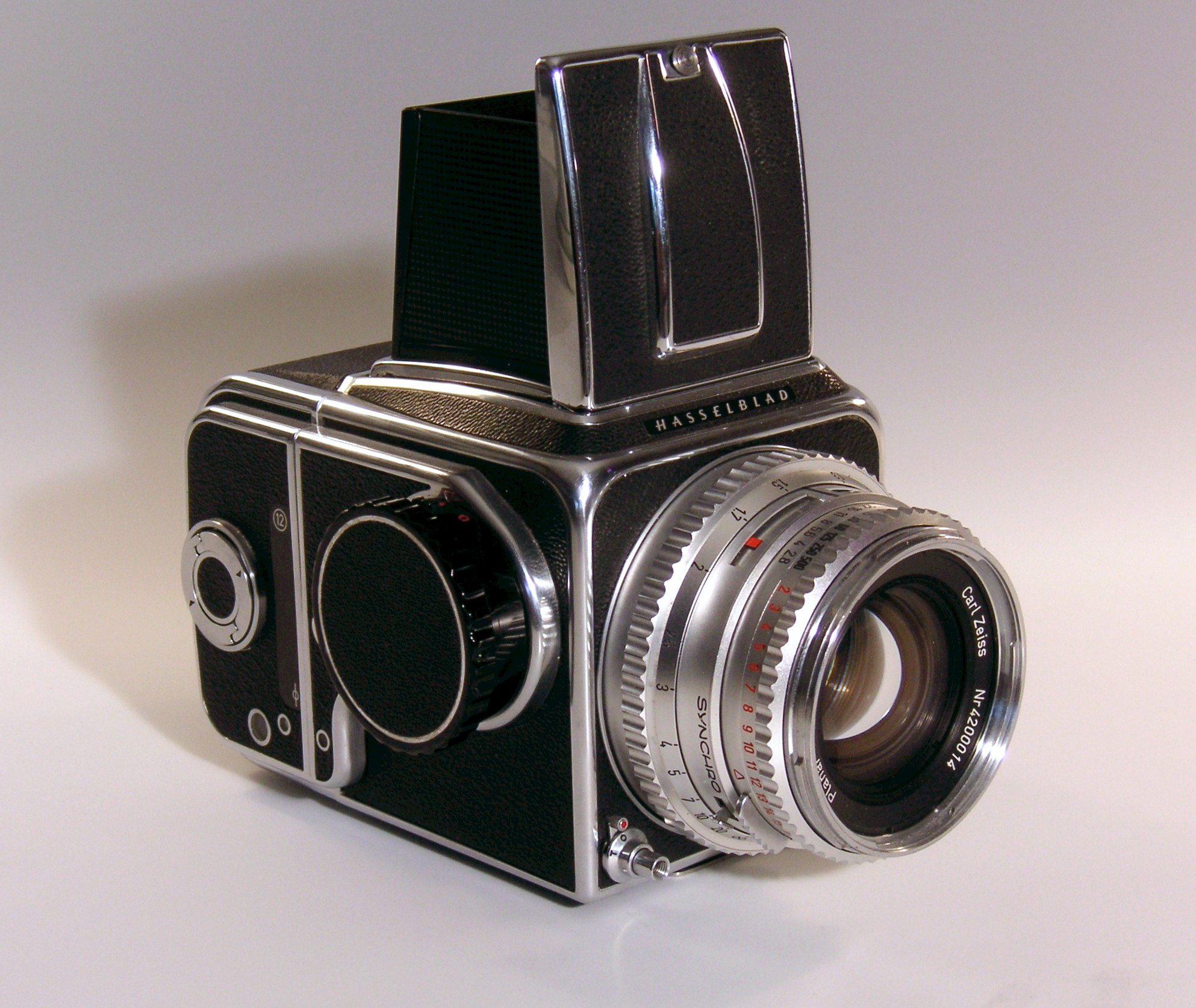


The Camera That Went to the Moon
Almost every photograph you have ever seen of an astronaut standing on the Moon — the bootprint in grey dust, the gold-visored figure, the whole blue Earth hanging in black space — was taken with a Hasselblad 500C or one of its close relatives. That is a startling thing to sit with. The most important images humanity has ever made of itself were not captured by some purpose-built NASA machine, but by a boxy, hand-sized camera designed in Sweden by a man who really just wanted to photograph birds. The Hasselblad is the rare object that is quietly perfect: modular, mechanical, almost indestructible, and so well-resolved that a body built in the 1950s still works today. Its journey from a Gothenburg workshop to the Sea of Tranquility is one of the great stories in the history of design — proof that when a tool is made honestly enough, the world will end up trusting it with its most important pictures.
달에 다녀온 카메라
우주비행사가 달 위에 서 있는 사진 — 회색 먼지 속의 발자국, 금빛 바이저를 쓴 형체, 검은 우주에 떠 있는 푸른 지구 전체 — 여러분이 본 그 거의 모든 장면은 하셀블라드 500C(Hasselblad 500C) 혹은 그 가까운 형제들로 촬영된 것이다. 곰곰이 생각하면 놀라운 사실이다. 인류가 스스로를 담은 가장 중요한 이미지들은 NASA가 특별히 제작한 어떤 기계가 아니라, 사실은 그저 새를 찍고 싶었던 한 남자가 스웨덴에서 설계한 손바닥만 한 각진 카메라로 찍혔다. 하셀블라드는 조용히 완벽한, 보기 드문 물건이다. 모듈식이고, 기계식이며, 거의 파괴 불가능하고, 너무나 잘 완결되어 있어 1950년대에 만든 바디가 지금도 작동한다. 예테보리의 작업장에서 ‘고요의 바다’에 이르기까지의 여정은 디자인 역사상 가장 위대한 이야기 가운데 하나다 — 도구가 충분히 정직하게 만들어지면, 세상은 결국 가장 중요한 사진을 그 도구에 맡기게 된다는 증거다.


A Bird Photographer’s Dream
Victor Hasselblad came from a Gothenburg family that had long imported photographic goods, but his own passion was the wild — he was a serious ornithologist who wanted a camera that could catch a bird in flight and still fit comfortably in the hand. In 1948 his company released the 1600F, the first civilian Hasselblad, and with it a radical idea: instead of a fixed, all-in-one camera, build a modular system. The body would be a simple cube; the lens, the viewfinder, and the film magazine would all clip on and off, so a photographer could swap film mid-roll or change formats without carrying three separate cameras. The breakthrough model came in 1957. The 500C moved the shutter out of the body and into the lens itself — a Synchro-Compur leaf shutter, built by Zeiss — which made the whole system more reliable and let it synchronise with flash at every speed. It was elegant, logical, and built like a fine instrument. It was also, though no one yet knew it, exactly the kind of camera an astronaut would want.
새를 찍고 싶었던 사람의 꿈
빅토르 하셀블라드(Victor Hasselblad)는 오랫동안 사진 용품을 수입해 온 예테보리 집안 출신이었지만, 그의 열정은 자연을 향해 있었다. 그는 진지한 조류학자였고, 날아가는 새를 잡아채면서도 손안에 편안히 들어오는 카메라를 원했다. 1948년 그의 회사는 첫 민간용 하셀블라드인 1600F를 내놓았고, 그와 함께 급진적인 발상을 제시했다. 고정된 일체형 카메라 대신 모듈식 ‘시스템’을 만들자는 것이었다. 바디는 단순한 정육면체이고, 렌즈·뷰파인더·필름 매거진은 모두 탈착식이어서, 사진가는 롤 중간에 필름을 바꾸거나 카메라 세 대를 들고 다니지 않고도 포맷을 바꿀 수 있었다. 결정적인 모델은 1957년에 나왔다. 500C는 셔터를 바디에서 렌즈 안으로 옮겼는데 — 자이스가 만든 신크로-콤푸어 렌즈 셔터였다 — 덕분에 시스템 전체가 더 안정적이 되었고 모든 속도에서 플래시 동조가 가능해졌다. 우아하고 논리적이며, 정밀 기기처럼 만들어졌다. 그리고 아직 아무도 몰랐지만, 그것은 바로 우주비행사가 원하게 될 그런 종류의 카메라이기도 했다.


NASA Comes Calling
The Hasselblad reached space the way the best tools often do: because someone who loved it brought it to work. Astronaut Wally Schirra was a keen amateur photographer who already owned a 500C, and he suggested NASA use it to document human spaceflight rather than commission something new. The engineers agreed — but the camera went on a diet first. They stripped off the leather covering, the reflex mirror, the auxiliary shutter and the standard viewfinder, painted the body matte black to kill reflections in the spacecraft window, and fitted a new magazine that held 70 exposures instead of the usual twelve. This lean, blacked-out 500C flew on Mercury-Atlas 8 in October 1962, and the crisp images Schirra brought back from six orbits of Earth began a partnership between the Swedish manufacturer and the American space agency that would last for decades. It is a quietly moving detail: the camera that changed how we see our own planet started as one man’s personal hobby gear.
NASA가 문을 두드리다
하셀블라드는 최고의 도구들이 흔히 그러하듯 우주에 도달했다 — 그것을 아끼던 누군가가 일터에 가져왔기 때문이다. 우주비행사 월리 시라(Wally Schirra)는 열성적인 아마추어 사진가로 이미 500C를 갖고 있었고, NASA가 새로운 장비를 의뢰하는 대신 이 카메라로 유인 우주비행을 기록하자고 제안했다. 엔지니어들은 동의했지만, 카메라는 먼저 ‘다이어트’에 들어갔다. 가죽 커버, 반사 거울, 보조 셔터, 표준 뷰파인더를 떼어 내고, 우주선 창에 반사가 생기지 않도록 바디를 무광 검정으로 칠했으며, 보통 12장 대신 70장을 담는 새 매거진을 달았다. 이 가볍고 검게 칠한 500C는 1962년 10월 머큐리-아틀라스 8호에 실려 날아올랐고, 시라가 지구를 여섯 바퀴 돌며 가져온 선명한 사진들은 스웨덴 제조사와 미국 우주국 사이의 수십 년에 걸친 협력의 시작이 되었다. 조용히 뭉클한 대목이다. 우리가 우리 행성을 보는 방식을 바꾼 그 카메라가, 실은 한 사람의 개인 취미 장비에서 출발했으니 말이다.


Engineering for the Moon
For the Apollo landings, the camera was reinvented once more as the Hasselblad Electric Data Camera. It was fitted with a specially computed Zeiss Biogon lens and, most distinctively, a glass Réseau plate etched with a grid of small crosses that appear on every frame — those little “+” marks scattered across the lunar photographs are not defects but a deliberate measuring tool, letting scientists calculate distances and dimensions from the pictures. Chest-mounted so an astronaut in bulky gloves could shoot without raising it to the eye, the camera had to endure a vacuum, wild temperature swings and abrasive Moon dust, and it simply worked. When Apollo 11 lifted off from the surface, weight was so precious that the crew unclipped the film magazines and left the camera bodies behind; from Apollo 11 through Apollo 17, roughly a dozen Hasselblad bodies were abandoned on the Moon, where they sit to this day. What came home was the film — and on it, some of the most important photographs ever taken.
달을 위한 설계
아폴로 착륙을 위해 카메라는 다시 한 번 하셀블라드 전자 데이터 카메라(HEDC)로 다시 태어났다. 특별히 계산된 자이스 비오곤(Biogon) 렌즈가 장착되었고, 가장 특징적으로는 작은 십자들이 격자로 새겨진 유리 레조 판(Réseau plate)이 들어가 모든 프레임에 나타났다 — 달 사진 곳곳에 흩어진 그 작은 ‘+’ 표식들은 결함이 아니라 의도된 측정 도구로, 과학자들이 사진으로부터 거리와 크기를 계산할 수 있게 해 주었다. 두꺼운 장갑을 낀 우주비행사가 눈에 대지 않고도 찍을 수 있도록 가슴에 장착된 이 카메라는 진공, 극심한 온도 변화, 거친 달 먼지를 견뎌야 했고, 그저 묵묵히 제 역할을 해냈다. 아폴로 11호가 달 표면에서 이륙할 때 무게가 너무나 귀했던 나머지, 승무원들은 필름 매거진만 떼어 내고 카메라 바디는 남겨 두었다. 아폴로 11호부터 17호까지 약 열두 대의 하셀블라드 바디가 달에 버려졌고, 지금도 그 자리에 놓여 있다. 집으로 돌아온 것은 필름이었고 — 그 위에는 인류가 찍은 가장 중요한 사진 몇 장이 담겨 있었다.


Why the System Endures
The remarkable thing about the Hasselblad 500 series is that its logic never really aged. Because the system is modular and almost entirely mechanical, a 500C/M from 1970 can still be loaded with film and shot today, its leaf shutter ticking away exactly as it did half a century ago — no batteries, no menus, no obsolescence. That durability made it beloved not only by NASA but by studio photographers, portraitists and landscape masters, from Ansel Adams to countless fashion shooters who prized the deep, square medium-format image. And Hasselblad has never let the Moon connection fade: its modern digital 907X Special Edition deliberately echoes the black-and-silver look of the lunar cameras, a modern tribute to the same modular idea. In an era of disposable gadgets, the 500C stands for the opposite philosophy — buy once, repair forever, and pass it down. Whether you are drawn to a vintage film body or a new digital tribute, this is a camera that rewards a lifetime of use.
이 시스템이 오래 남는 이유
하셀블라드 500 시리즈의 놀라운 점은 그 논리가 사실상 낡지 않았다는 것이다. 시스템이 모듈식이고 거의 전부 기계식이기 때문에, 1970년의 500C/M도 지금 필름을 넣어 촬영할 수 있고, 렌즈 셔터는 반세기 전과 똑같이 째깍이며 작동한다 — 배터리도, 메뉴도, 노후화도 없다. 이 견고함 덕분에 하셀블라드는 NASA뿐 아니라 스튜디오 사진가, 초상 작가, 풍경 대가들에게도 사랑받았다. 앤설 애덤스부터, 깊고 정사각형인 중형 포맷 이미지를 아꼈던 수많은 패션 사진가들까지 말이다. 그리고 하셀블라드는 달과의 인연을 결코 잊게 두지 않았다. 현대의 디지털 907X 스페셜 에디션은 달 카메라의 검정과 은색 외관을 일부러 그대로 되살린, 같은 모듈식 발상에 대한 현대의 헌사다. 일회용 기기의 시대에 500C는 정반대의 철학을 상징한다 — 한 번 사서, 영원히 고쳐 쓰고, 물려주는 것. 빈티지 필름 바디에 끌리든 새 디지털 헌정판에 끌리든, 이 카메라는 평생의 사용을 보답해 준다.


Why the Hasselblad 500C Still Matters
The deepest lesson of the Hasselblad 500C is about trust. NASA did not go looking for a spectacular gadget; it reached for the most honest, reliable tool it could find, one already proven in the careful hands of working photographers — and that tool repaid the trust by returning images that reshaped how our whole species sees itself. Great design is not about novelty for its own sake; it is about building something so sound that it can be relied on when everything is on the line. The 500C sits in the same family as a well-made chair or a good fountain pen: an object that hides its cleverness inside utter usefulness, and quietly outlives the fashions around it. Half a century on, its shutter still fires, its pictures still hang in museums, and a dozen of its bodies still rest on the Moon — a fitting monument to a camera that was simply, thoroughly, well made.
If you enjoy stories of everyday objects designed to last, you might also like our looks at the Lamy 2000 fountain pen and the Eames Lounge Chair.
하셀블라드 500C가 여전히 중요한 이유
하셀블라드 500C가 주는 가장 깊은 교훈은 ‘신뢰’에 관한 것이다. NASA는 화려한 기기를 찾아 나서지 않았다. 그들은 찾을 수 있는 가장 정직하고 믿을 만한 도구, 이미 현업 사진가들의 세심한 손끝에서 검증된 도구에 손을 뻗었고 — 그 도구는 우리 종(種) 전체가 스스로를 바라보는 방식을 바꾼 이미지들로 그 신뢰에 보답했다. 위대한 디자인은 새로움 그 자체를 위한 것이 아니다. 모든 것이 걸려 있을 때 기댈 수 있을 만큼 견실한 무언가를 만드는 일이다. 500C는 잘 만든 의자나 좋은 만년필과 같은 가족에 속한다. 자신의 영리함을 철저한 쓸모 안에 감추고, 주변의 유행보다 조용히 더 오래 살아남는 물건이다. 반세기가 지난 지금도 그 셔터는 여전히 작동하고, 그 사진들은 여전히 미술관에 걸려 있으며, 그 바디 열두 대는 여전히 달 위에 놓여 있다 — 그저, 철저하게, 잘 만들어진 카메라에 어울리는 기념비다.
오래 쓰도록 설계된 일상의 물건 이야기를 좋아한다면, 라미 2000 만년필과 임스 라운지 체어 이야기도 함께 볼 만하다.
Leave a Reply